
AI may help companies operate with fewer junior employees. But removing the first rung creates a problem automation cannot solve.
For decades, junior employees handled foundational work, developed judgment through experience, and gradually moved into positions of greater responsibility. AI is now disrupting that path — research, scheduling, reporting, drafting, and basic analysis can all be done faster without a junior hire. For companies under pressure to improve productivity, reducing junior hiring looks like efficiency. It hides a strategic risk.
Entry-level roles have never existed solely to complete tasks. They exist because that’s where employees learn how the organization actually works — how leaders interpret information, how customers respond and object, how decisions really get made behind the scenes. If AI removes the tasks without replacing the learning, companies will eventually find they have fewer people prepared to step into mid-level and senior roles.
The shift is already underway. In a 2026 survey of 415 CEOs by the Oliver Wyman Forum and NYSE, the share planning to deprioritize junior hiring jumped from 17% to 43% in a single year. But here’s what’s telling: among companies furthest along in AI adoption, the pattern reverses — 24% plan to increase junior hiring, treating AI as a force multiplier for early-career talent rather than a replacement for it. That’s evidence this is a choice, not an inevitability.
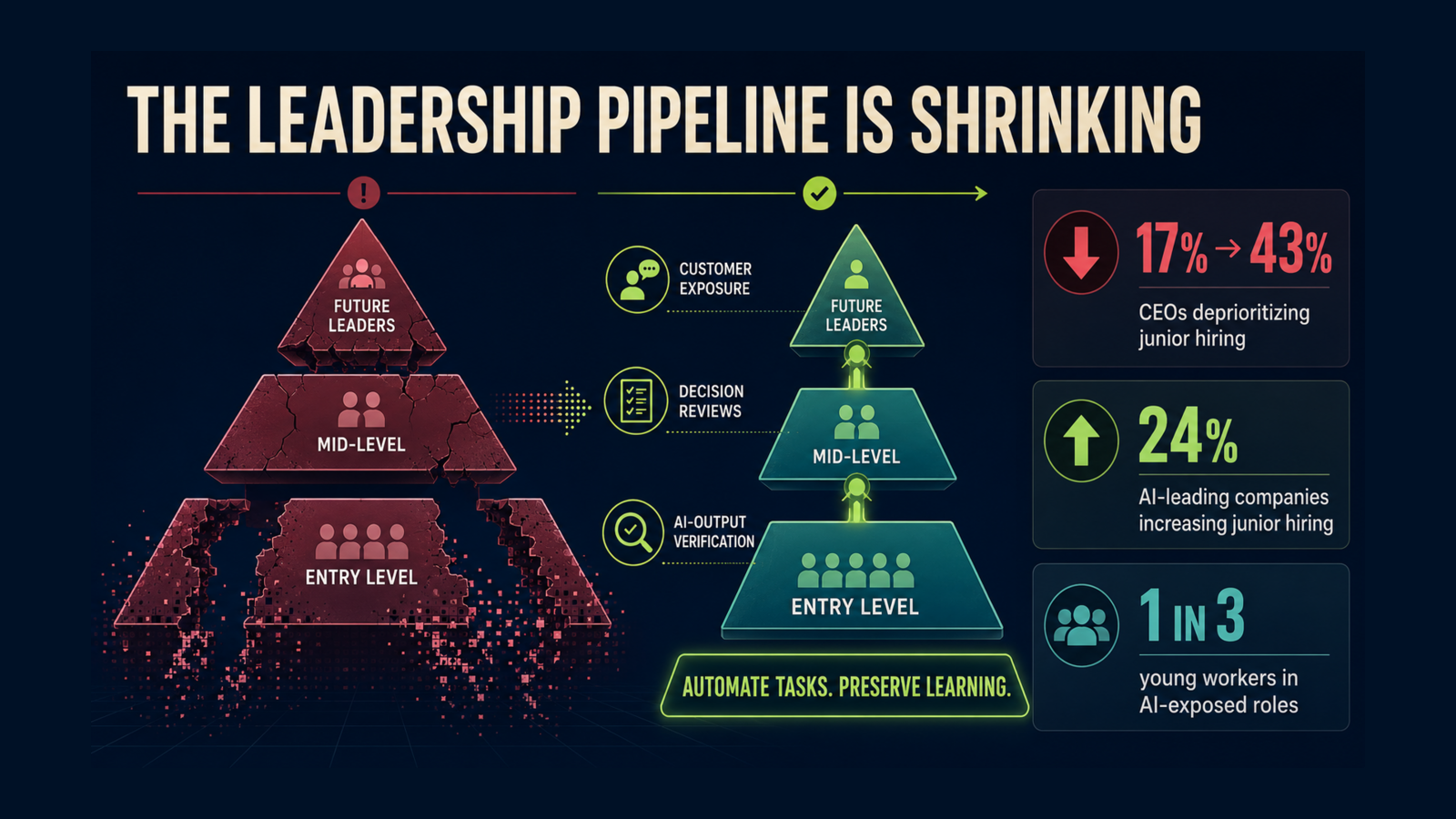
The more useful question isn’t how many junior positions AI can eliminate — it’s how people will develop judgment once AI performs the work through which judgment was traditionally learned. That means giving junior employees earlier exposure to customer conversations, decision reviews, and AI-output verification: the situations that actually build it.
That tension — between using AI to move faster and using it to build something durable — is exactly what Harvard Business School professors Marco Iansiti and Karim R. Lakhani take on in Competing in the Age of AI. Their claim: advantage doesn’t come from adding AI to an existing company. It comes from rebuilding how the company operates around data, algorithms, and digital networks — including how it develops the people inside it.
Consider Ant Financial, the book’s opening case: by 2019, it served over a billion consumers with one-tenth the headcount of the largest US banks, valued at $150 billion. It didn’t get there by hiring faster — it built a company where the work is done by software that improves every time it runs. Traditional businesses grow linearly, requiring more people for more customers. AI-centric businesses, once their digital foundations are established, don’t.
Two ideas worth carrying into the boardroom: Transformation begins with the operating model, not with which AI tool to buy — the real question is how the business should operate if intelligence is embedded into every process. And every interaction should make the business smarter: in a traditional company, a transaction closes the loop; in an AI-centric one, it opens one, feeding the next decision.
Both come from the same argument, worked out in full over 250 pages.
Read Competing in the Age of AI
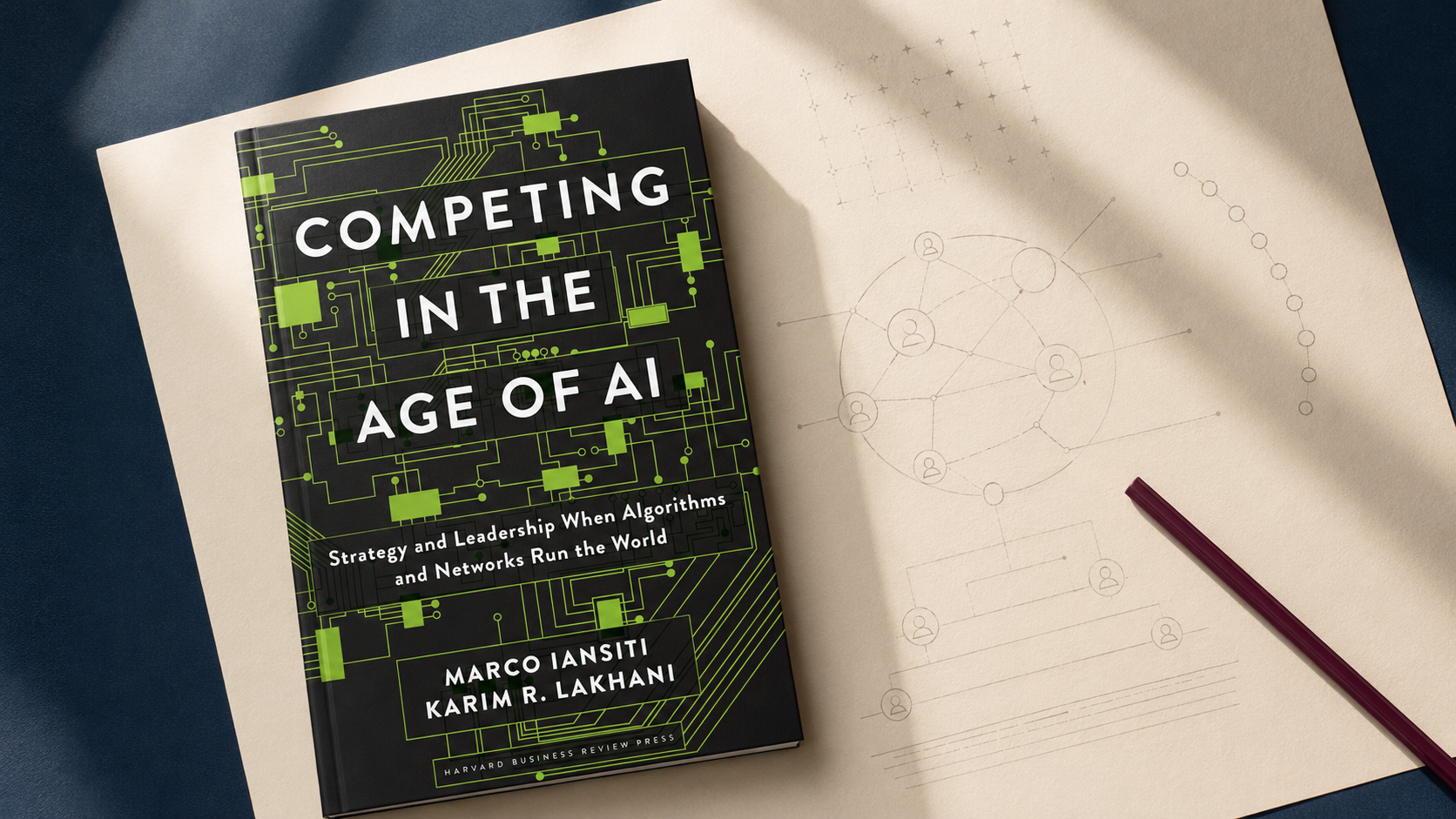
Competing in the Age of AI is a strategic framework for leaders deciding what kind of organization to build, not a guide to using AI tools — and published in 2020, before generative AI entered a single boardroom agenda, its thesis has held through the industry’s most disruptive stretch.
Best for: Executives accountable for how their organization operates, rather than which tools it buys. Reading commitment: around six hours.
If the operating model is where strategy starts, the tools your team actually uses are where it shows up day to day. One worth a look this month: Granola, an AI meeting notetaker built for people who already take notes.
Most AI notetakers join your call as a visible bot, record everything, and hand back a transcript-heavy summary you skim once and archive. Granola works differently — it runs quietly in the background of your existing video call, no bot, no visible participant, and takes your own rough, real-time notes and enriches them with what was actually said, matched to what you cared enough to jot down.
A full transcript answers “what was said.” Granola answers “what mattered,” because it starts from the notes a senior person chose to take, not from every word spoken in a 45-minute call — and because there’s no bot joining the meeting, it works in exactly the settings where an obvious recording presence would be unwelcome: board meetings, investor calls, client conversations.
It won’t help teams that don’t already take notes — it enriches judgment, it doesn’t manufacture it — and it’s built for individual use rather than a shared team archive. But for executives who want a sharper version of their own notes, rather than a transcript they’ll never reread, it’s worth the month’s attention.
And if you’re looking to put your own judgment in front of a wider audience, this month brings a discounted feature placement in Entrepreneur Magazine, arranged through TEI’s media relationships. A feature there carries real weight with investors, partners, and prospective hires — and this issue’s subscribers have access to a placement rate not available through standard channels, with editorial support from TEI’s team handling the interview, drafting, and placement end-to-end. Spots are limited this issue.
Interested? Talk to our team to learn more about this opportunity and discuss the details. Schedule a call through our Calendly, or simply reply to this email and we’ll be happy to assist.
Take with you: Are you using AI to complete today’s work faster — or to build a fundamentally better business, with people who can lead it, for tomorrow?
The Executive Insight — 169 Madison Ave STE 11570, New York, NY, 10016