
Every business has a set of processes that work perfectly, as long as one specific person is available to answer a question about them.
The clearest sign of this is turning up in the AI numbers. A Goldman Sachs survey of small business owners released in March 2026 found that 76% were using AI in some form. Only 14% said it was fully embedded in their core operations, and 73% said they would benefit from more training and implementation support. Owners pointed to a lack of technical expertise and difficulty choosing tools.

My read is that there is a simpler explanation underneath those answers, though the survey doesn’t test it. You cannot embed anything into a process that has never been written down. A tool can be pointed at a documented sequence of steps. It cannot be pointed at a judgment you make differently each time, or at the thing you always remember to check because you have been doing this for a decade. The 14% is probably not only a technology gap. Part of it may be a documentation gap that the technology made visible.
Meanwhile the owner absorbs the difference. A 2026 survey of 1,000 small business owners by Talker Research for Adobe Express, which is sponsored research and worth reading as such, found the average owner wears five different hats in a day and puts in more than 200 unpaid extra hours a year. The survey can’t tell us how much of that is interruption, but some of it surely is: the question only you can answer, asked by someone perfectly capable of doing the work if the answer existed anywhere else.
Donald Miller’s Business Made Simple is a 60-day curriculum rather than an argument, which makes it easy to dismiss and useful to steal from. Its management section starts where most owners skip: define the measurable output of a role before describing how the job gets done. What does it produce, how would you know it was produced well, and how does it contribute to the business making money? Its approach to projects applies the same logic, with a launch meeting that defines success and ownership, a one-page record kept visible, and a short recurring check on progress and obstacles.
Strip away the specifics and the lesson is to make explicit the three things that otherwise live in the owner: what finished looks like, who decides, and what we check. If those are written anywhere, the process can run without you. If not, you are the process.
Two changes follow.
Capture it the next time you explain it, not in a documentation project. Documentation efforts fail because they are scheduled as work with no deadline. The alternative is to treat the next question as the trigger. When someone asks how to do the thing, do it once while capturing what you do, then send them the result instead of the explanation. You were going to spend the time anyway. The difference is whether it exists afterwards.
Write what done looks like, not only the steps. A list of steps tells someone what to press. It does not tell them whether the result is right, which is why work still comes back to you for approval. One line at the top of each process, describing the output and how you would judge it, removes most of those return trips. It is also the part only you can write, which makes it the worst possible candidate for delegation and well worth a few minutes of your time.
Read Business Made Simple →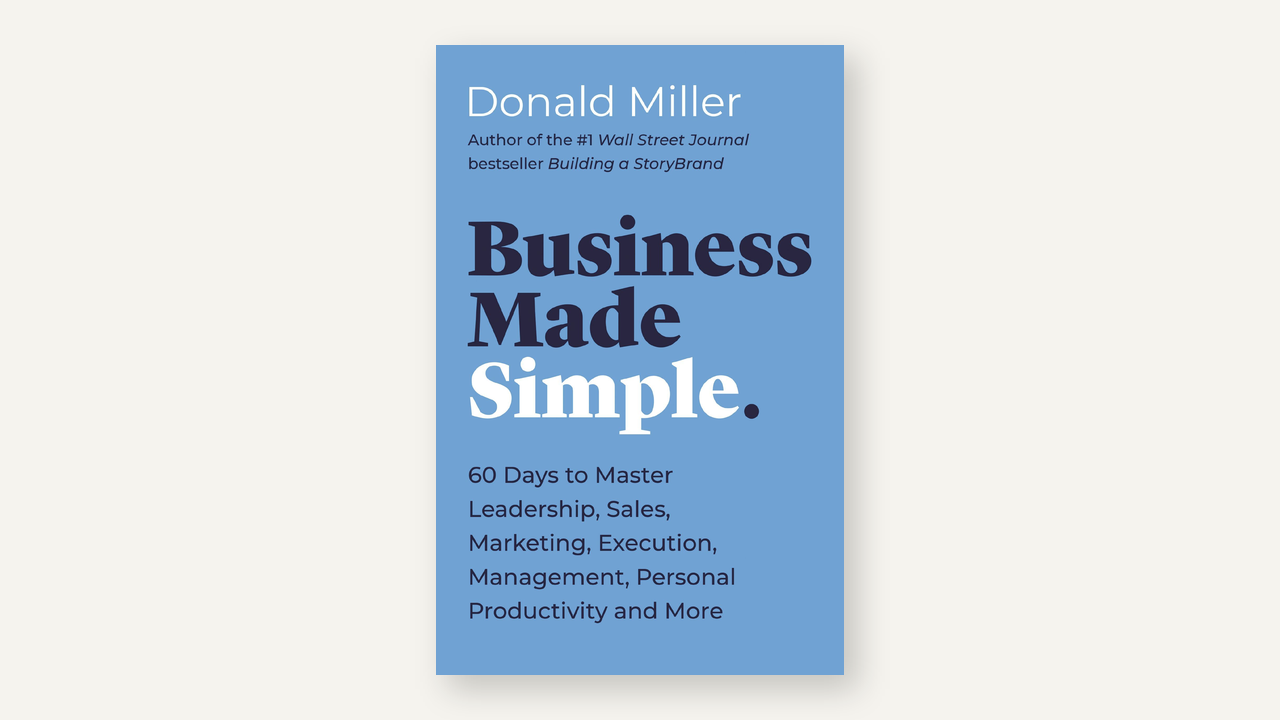 Best for: Owners who want a practical curriculum to work through rather than a single argument to be persuaded by.
Reading commitment: About five hours, organized as 60 short lessons, easy to read in pieces.
The capture step is where most of this dies, because writing instructions is slower than doing the task. A category of tools now records the task as you perform it and turns it into the guide.
Scribe is one example. It watches a process being done in the browser or on the desktop, then produces a step-by-step guide with screenshots and written instructions, which you edit rather than author. The practical effect is that documenting a process costs roughly the time it takes to do it once.
Three limits matter. The guides are screenshots of software at a moment in time, so they age whenever the underlying tool changes, and reviewers consistently mention the maintenance burden. Desktop capture and features like redacting sensitive information sit on the paid tiers, and the team pricing starts at a five-seat minimum, which is awkward for a business with three people who need it. And it captures what you clicked, not why, which is exactly the judgment that keeps work coming back to you. The definition of done still has to be written by hand.
Take with you: Which part of your week only happens because someone can ask you a question?
TEI offers a feature placement in USA Today, arranged through our media relationships. USA Today reaches a general readership rather than a trade one, which suits a story about how a business is actually run. If it’s of interest, book a call on our Calendly or reply to this email.
The Executive Insight, 169 Madison Ave STE 11570, New York, NY, 10016