Subscribe to outperform
The weekly Executive Briefing: insights, books, tools, and media opportunities worth your attention — curated and distilled into 5 minutes.


The invitation to the leadership offsite says “smart casual”, and the questions start at once. Jacket or no jacket? Jeans? Trainers? For most companies, the smart casual dress code men are asked to follow comes down to a simple formula: a jacket you could take off, a shirt with a collar, trousers that are not part of a suit, and good leather shoes. The details below are about reading the room once you have that base.
This piece covers what the term means, the pieces that work, the pieces to leave at home, and how to adjust for the event, the company and the season.
Nobody has a precise definition, and that is part of the problem. Wikipedia’s entry describes smart casual as an ambiguously defined Western dress code, generally considered casual wear but with smart elements of a lounge suit, and notes that personal judgement is required to interpret it. It quotes the Italian tailoring house Brioni saying it is not an issue of inventory or classification but rather of knowledge and good taste.
The term is old. The same entry traces the earliest known use to an Iowa newspaper in 1924. Business casual grew out of it decades later. In practice, smart casual sits a step above business casual in the evening and a step below it in a conservative office, which is why the same invitation can mean different things in different companies.
The useful working definition is this: smart casual is what you would wear to meet an important client for lunch on a Friday. Relaxed enough to show you are not at a board meeting. Considered enough that nobody wonders whether you made an effort.
Jacket. An unstructured blazer or sports jacket in navy, grey, brown or olive is the most useful single piece. It instantly makes the rest of the outfit look intentional, and it comes off if the room is more relaxed than you expected. The menswear site Gentleman’s Gazette lists blazers and odd jackets as the formal end of smart casual, with cotton, linen, suede and Harrington jackets as more casual options. What it rules out is a full suit.
Shirt or knit. An oxford cloth button-down, a linen shirt in summer, or a fine knit polo. Collars matter: they are the simplest signal of “smart”. A plain T-shirt under a jacket can work in a creative company, but it is the riskiest choice for a first event.
Trousers. Chinos are the default, in stone, navy or olive. Wool or flannel trousers in a grey that does not match your jacket work well in colder months. Corduroy has come back for autumn and winter. Jeans are the most debated item, which we come to below.
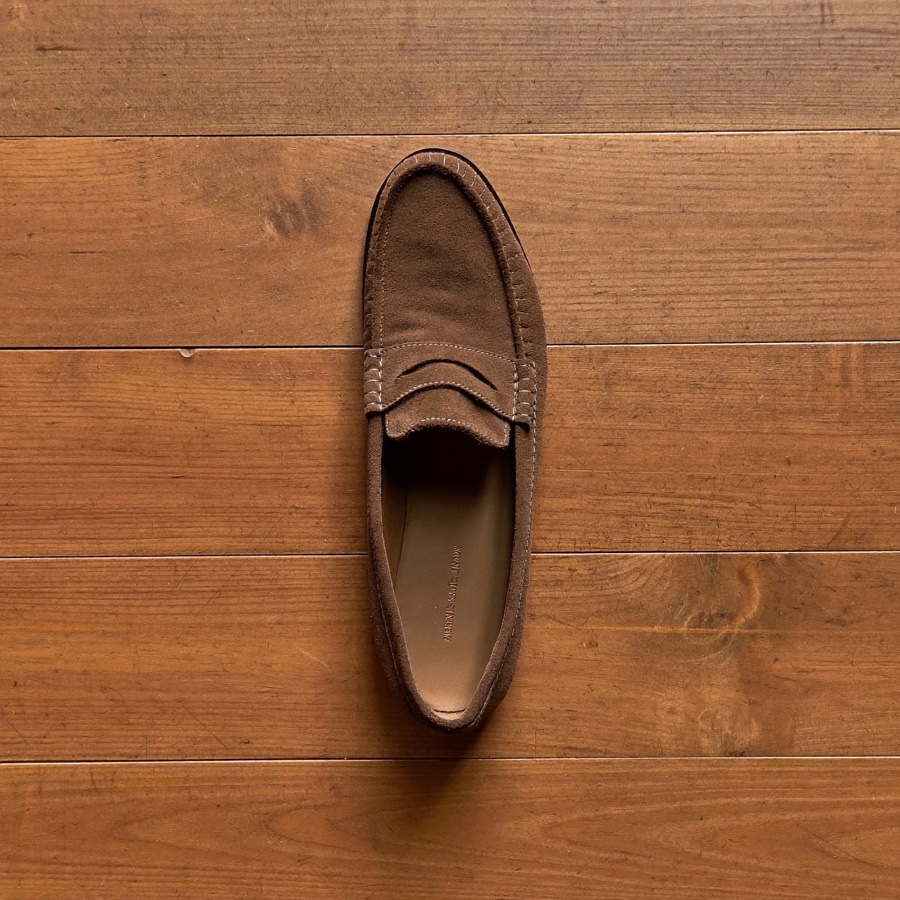
Shoes. Leather or suede loafers, derbies, chukka boots or clean brown brogues. Gentleman’s Gazette suggests brown, tan, burgundy and similar shades over black dress shoes, which read as office. Clean minimal leather trainers are a grey area: accepted at many tech and creative companies, a risk at a law firm’s dinner.
Accessories. A leather belt that roughly matches your shoes and a simple watch. No tie is the normal reading. If you want something at the neck, a knitted tie with a jacket can work in a more traditional setting, but most guides would leave it off.

The common mistakes are at both ends. Arriving in a full suit and tie makes you look as if you misread the invitation, and suggests you cannot relax. Arriving in a hoodie, shorts or running shoes suggests you did not read it at all.
Jeans are where opinions split. Gentleman’s Gazette puts them outside smart casual altogether. Many offices treat dark, well-fitting jeans with no fading or rips as acceptable, especially with a jacket and leather shoes. The safe rule for a first event with a new employer or client is chinos. Once you have seen what others wear, adjust.
Avoid anything with a large logo, athletic wear that looks like athletic wear, and anything you would wear to cut the grass. Smart casual should look chosen, not grabbed.
The same invitation means different things depending on three things: the industry, the time of day and the venue.
A bank’s offsite at a country hotel leans formal: jacket on, collar, leather shoes. A software company’s team dinner leans relaxed: knitwear and clean trainers may be the norm. An evening event leans smarter than a daytime one. A venue with a dress policy of its own, such as a private members’ club, may set the floor for you.
When in doubt, dress one notch up and bring the option to take it down. A jacket you can hang on the back of a chair solves most of the uncertainty. Taking a jacket off is easy. Adding one you did not bring is not.
Look at the people who organised the event. If you know who wrote the invitation, look at what they wore last time. That is usually the most reliable guide to what they meant.
The same principles hold all year, but the fabrics change, and getting the fabric wrong is the most common way a well-chosen outfit still looks off.
Summer. Swap the wool blazer for cotton or linen in a lighter shade, and the oxford shirt for linen or a short-sleeved knit polo. Light chinos in stone or pale grey work well. Loafers without visible socks are standard at a summer offsite. Linen creases, and that is accepted; it is part of the look.
Autumn and spring. This is the easiest season for smart casual. A brushed cotton or light wool jacket, an oxford shirt, a fine merino jumper over it if the day is cool, and chinos or flannel trousers. Suede shoes come into their own.
Winter. Heavier textures do the work: tweed or flannel jackets, corduroy trousers, a roll-neck jumper in place of a shirt. A roll-neck under a jacket is one of the few ways to look smart without a collar, and it is widely accepted under a smart casual dress code. Chukka boots or derbies handle wet streets better than loafers. Add a proper overcoat rather than a sports jacket, because the coat is what people see as you arrive.
Colour follows the season too. Lighter, softer colours suit summer, deeper tones suit winter. If you are unsure, navy, grey and brown work in every month and with each other.
Travel is the other variable. For a two-day offsite, one jacket, two shirts, one knit, two pairs of trousers and one pair of shoes worn on the journey is enough. Everything should go with everything else, so you are not building a new outfit each morning.

Clothes are a small signal, but people read them fast. At an offsite or a client dinner, the first judgement is made before anyone has heard you speak, and a dress code misread in either direction becomes a story you did not intend to tell.
That makes it a small, practical part of how people come across, alongside how they write and speak. Our guide on what to post on LinkedIn covers the written version of the same idea: show judgement, not effort. And if the offsite is the start of a new role or a new venture, our piece on how to start a consulting business covers how independent consultants decide how to present themselves to clients who are paying for judgement.
You do not need much. A navy unstructured blazer, two oxford shirts, a fine knit polo, stone and navy chinos, grey wool trousers, brown suede loafers and a pair of brown leather derbies will cover nearly every smart casual invitation of the year. Choosing from a small set also saves a decision each morning, which our decision making matrix piece would class as exactly the kind of low-stakes choice worth removing.
Pack it the night before the offsite, so the morning is about the meeting, not the wardrobe. Our pieces on how to get more deep sleep and Andrew Huberman’s morning routine cover the rest of the preparation that matters more than any jacket.
An offsite is mostly conversation, and the clothes are there to stay out of the way of it. If the agenda includes a hard strategic choice, our piece on dialectical thinking is a good preparation for holding two positions in the room at once, and our critical thinking exercises are designed for exactly that kind of session.
For the travel time, our list of psychology books and our piece on Bill Gates’ reading list will serve you better than the inbox. And if the offsite is where compensation or retirement benefits come up, our guides to Roth IRA vs brokerage account and 403b vs 401k cover the questions people ask over dinner and rarely in a meeting.
Related from our newsroom: what 39 CEOs actually do before work, a sourced look at their wake times and first hours.
The smart casual dress code men find confusing is mostly a test of judgement. Bring the jacket, wear the collar, choose good shoes, and let the conversation do the rest.

Written by
Editor of The Executive Insight. Writes about leadership, decision-making and the parts of building a business that nobody puts in the plan.

Discover Africa writer Thaakiera Ackerdien was on the ground in Zimbabwe’s Matusadona National Park for Discover Africa Safaris, a Cape Town-based operator building tailor-made safari itineraries across Southern and East Africa, as African Parks completed a rare translocation: 17 black rhinos, the first wild rhinos in over a decade, now inside a 175-square-kilometer zone set […]
Family hospitality group Familux Resorts has acquired two new properties on the Baltic Sea and in the Dolomites, its first expansion beyond the Alpine region.
You send a message to a colleague in Amsterdam at seven in the evening, and the reply arrives at nine the next morning, complete and on time. If you have wondered which countries with best work life balance are getting this right, the most reliable comparison comes from the OECD’s Better Life Index. On its […]
The board wants an outside view on the transformation programme, and the shortlist has two kinds of names on it: one of the big 4 consulting firms and one of the strategy houses. The big 4 consulting firms are Deloitte, PwC, EY and KPMG, the […]
You send a message to a colleague in Amsterdam at seven in the evening, and the reply arrives at nine the next morning, complete and on time. If you have wondered which countries with best work life balance are getting this right, the most reliable […]
The annual review ends with a line about “development needs”, HR sends a link to an online course library, and nothing much changes. If you are asking what is upskilling, the short answer is this: it means learning new skills that make you better at […]

You opened a Roth IRA in your fifties, you are now 60, and you want to take some of the growth out for a kitchen. The roth ira 5 year rule decides whether that withdrawal is tax free. It is really two separate clocks: one […]

The strategy offsite produced a page of words like “customer-centric” and “operational excellence”, and on Monday nobody knows what to do differently. That gap is the difference between abstract and concrete thinking. Concrete thinking deals with what you can see, touch and check in the […]

It is eleven in the morning, the third coffee is half finished, and the email you have been avoiding suddenly feels like an emergency. The link between caffeine and anxiety is real, and it is easy to miss because caffeine does exactly what you want […]

The business made money this year, the accountant mentions “an S corp election”, and suddenly the structure you set up in an afternoon three years ago is a question again. The llc vs s corp choice is less of a choice than it sounds: an […]

The appraisal form has a box marked “goals for the next twelve months”, and most people fill it with something that sounds right and means nothing: “grow as a leader”, “take on more responsibility”. Short term career goals are useful only when they are specific […]

The offer from the hospital group is good, the role is bigger, and somewhere in the benefits pack is a line saying the retirement plan is a 403(b) rather than the 401(k) you have had for fifteen years. For most people weighing 403b vs 401k, […]

Their wake times, first hours and sleep before work, with every routine sourced. Tim Cook gets up “a bit before four.” He said it years ago, and it has been repeated so often since that it reads like a job requirement. Most advice on the […]
The weekly Executive Briefing: insights, books, tools, and media opportunities worth your attention — curated and distilled into 5 minutes.

Welcome to The Executive Insight. Your free AI guide to the best tools is on its way. The first issue arrives soon. Check your promotions tab if it is not in your inbox!
Your request has been successfully submitted. Please wait for a reply from our manager, he will contact you as soon as possible.
Your copy of The Executive Insight Book Challenge List is downloading now. Enjoy the list — and while you're here, take a look at our latest interviews.