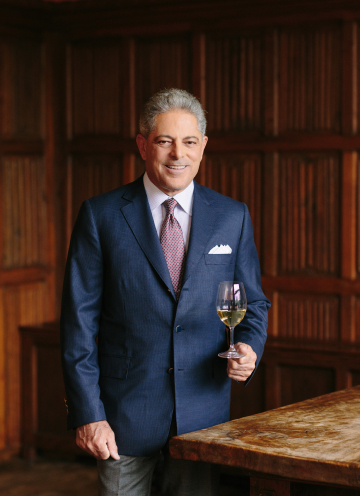
"Fior di Sole will continue to produce the best wine possible and bring the best value, quality and cost to the shelf and to the consumer's table."

Could you please provide a brief overview and history of the company?

My ex-wife and I moved from Italy in 1997 for family reasons. We wanted to go to the United States to find new opportunities and build our future in a new country. So we moved to Napa because I used to own a winery in Italy in the Veneto region. That was my business and expertise. So we came to Napa because it was and is still the place to be if you want to make great wine.

So we came here, and we were not ready at the beginning to have our own winery. We needed to understand the market and the law because Italy and the US have differences in the way that you do business with regards to legislation. We wanted to learn that first. We opened our first company that is still in business, Winetech, which provided services for other companies, mostly in filtration. We have other wineries to make wine.

Soon after that, we felt ready to embrace wine production. We started the winery in 2006. At the beginning, we were only making wine to sell in bulk. That’s how we started. A few years later, we started our first bottling line. At that time, we didn’t have a lot of capital. So, the first bottling line was made using the equipment that we purchased and refurbished myself. We started producing instead of bottling wine, which I’d been doing in Italy for at least 14 years prior to that. So I already had experience with that.

Unfortunately, that was probably the worst time to start producing, as the economy was really bad in 2008, 2007, and 2008. And so we looked at each other and said, “If we are going to survive this one, I think we’re going to be unstoppable.”

We were able to survive that moment. It was easier at that time because the company was very small. We didn’t have as many employees as we have right now. But we were able to grow the business. And a few years later, it really took off. Our production kept increasing and increasing, and we started producing all kinds of wines, from sparkling wine to still wine, with different labels and brands. We approach different export markets.

We really put a lot of energy and hard work into the wine business. We had a little advantage, though. We came from Italy after 14 years of hands-on experience. I used to own my winery over there and used to do a very similar thing that we do here, maybe at a smaller scale. But it was the same concept. Before that, it was my father’s winery. So it’s a generation of making wine. That helped us in starting the winery business in the US.

That’s beautiful. Thank you so much for your answer, which actually leads me to my next question. What would you say are your keys to success in the United States?

Even though we came here with experience—I have a master’s degree in enology—we came here with knowledge and also a little bit of money to start the business. Our approach was always very modest and humble.

We were here to learn, to see new ways, and hopefully, better ways to make better wine. Our approach was always respectful of what we found in this country. And I saw other people that did not move. They didn’t have that attitude. You come from Europe, where French wine and Italian wine, where the history of wine in the world happened. But they had a very uptight approach. We never had that. We were never afraid to wash things or clean floors. We really started from the bottom. Even though I had been managing a winery of about 20 people in the cellar for many years, when we came here, we started from the bottom again. With that, we gain a lot of respect from the people who work with us, our employees. I think that was one key to our success.

Another one is that we’re very receptive to the market, which changes weekly. We pride ourselves on being able to turn on a dime if necessary to follow the market or accommodate a customer request, even now with 160 employees and many brands.

Another strength is the technical part because we came with knowledge of bottling and winemaking. We brought new technology that we offer with our service company. And then, we use wine technology that was not really here before. We introduced that again not in an imposing way. We introduced that as a way to help other winemakers increase their profit or the quality of the wine that they make. So, I think those are probably the three main components.

Could you tell us about Fior di Sole’s portfolio of wines? Is there any brand that you would like to highlight in particular?

We have a few brands that actually became successful. The latest one is Caliveda. It was number one last year in total wine sales. It went basically from zero cases to, I think, 100,000 cases in a year.

Then, there is the Ca’ Momi, which is our own brand. That is the name of the place that we own in Italy. So it means the house of Momi. We have some history there. We believe in the history of that place. It’s just a house now. There is no vineyard. There is some land, but it’s just in honor of the owner of that property before we purchased it. His nickname was Momi. So, we name our house brand Ca’ Momi because this old man used to basically feed his six kids and wife for several years with just a few acres of land. He was very passionate about making wine in his vineyard. So, in his honor, we used that name for the Ca’ Momi label.

Could you quickly describe your array of services, specifically retailer, exclusive private label, bulk wine and custom bottling?

We do all of them. However, we’re mostly focused on private label and controlled brand retailer exclusives, which are our biggest businesses. I say we are almost 50 percent private label and 50 percent retailer exclusive.

We’ve done some custom bottling and added more capacity to our production line, so now we’ve opened the door to custom bottling. Before, we were not able to do that because of a lack of capacity. But now, we can easily add another 1 million cases to our production if needed. So, we can actually increase the custom bottling.

We can also do services for other wineries. For example, if we have to remove alcohol from wine, we have the technology to do that. That needs to be done in a licensed place so we can bring other wineries’ wines, treat them and give them back without alcohol.

We sell wine in bulk, but it is not our main business. We actually try to sell everything in bottles. But it does happen from time to time that if ever one of our private label customers requests us maybe for export, we do sell wine in bulk that way, or if we have an excess at the end of the year if the forecast was incorrect or something like that. That’s when we sell wine in bulk. We are not in the market to buy grapes and produce to sell wine in bulk. We buy the grapes and make the wine to bring it all the way to the finished product.

How do prioritize innovation? Perhaps you have some sustainability practices in place.

Yes. We’re very strong in innovation. It has been a journey, and that very first bottling line made with used equipment is long gone. Now, we have six production lines that are all state-of-the-art and the most advanced in California.

We pride ourselves on bottling all our wines without the addition of any preservative to prevent biological activity in the bottle. We don’t add anything as our wines are all very natural.

We pride ourselves on the low amount of water used in our winery. We used around 3 gallons of water per gallon of wine produced. Many other wineries in the valley have around 12 gallons of water per gallon of wine produced.

We use the highest technology in the cellar to prepare the wine for bottling. We also have a very gentle way of filtering wine using our proprietary filter, which we actually also sell to other wineries. As I said before, we have state-of-the-art bottling lines, all computerized with minimal operator intervention.

With regard to technology, we have everything that is pretty much available in the market to make great wine, including an optical sorting table to detect the bad berries from the field. We have gentle pressing of the grapes. We are very quality-oriented in the processing of the fruit to achieve a higher quality of wine.

What would you say would be your vision for the upcoming years?

This is a difficult market for wine at the moment. After COVID-19, the market went soft a little bit, not just for us but for other wineries as well. We actually did not lose any production, and we did introduce a new product.

Fior di Sole will continue to produce the best wine possible and bring the best value, quality and cost to the shelf and to the consumer’s table. We will try to keep up with the constantly changing tastes and preferences of the consumers to give them what they’re looking for.

We’ll continue to provide a safe place for the 260 people who work for this company to make it successful because we feel really responsible as owners for all these families. That’s our goal. We need to continue to make great wine and bring great value to the consumer in order to stay in business and provide for all the people who make this company good.

It’s not on my list of questions, but I just got curious. Do you export your wines? Do you ever export to Europe? I mean, in Europe, the market is very competitive, obviously, with the Spanish, Italian and French wines.

Yes, we export pretty much everywhere. We export to Europe, where we often submit to Swedish tenders. We export a little bit to England. We export to Asia, such as Japan, Korea and the Philippines. China, not much. We don’t work much at all with China. We used to, but then, somehow, that market changed. Of course, we work a lot with Canada.

I don’t think Europe is our strongest market because, as you said, the competition is very strong over there. But we do sell in Europe as well. Our biggest export market would be Japan.

Latest From The Executive Insight

  • Education

    A former nurse manager applies for an operations role. Her résumé says “excellent communication skills” and “strong leadership”. So do most of the other applications on the recruiter’s screen. The skills are real, and as written they are invisible. Good transferable skills examples always come […]
    9 min read
  • Wealth

    The spreadsheet says 52 is possible. You have run it three times, changed the return assumption twice, and it still works. Then come the questions the spreadsheet cannot answer: how to get money out of a 401k seven years early, who pays for health insurance […]

    8 min read
  • Mindset

    Forty minutes into the meeting, the team is still arguing about which of two suppliers to choose. Both options have been costed twice. Every new argument digs further into the same two answers. Lateral thinking is the habit of stopping at that moment and asking […]
    9 min read
  • Wellness

    Thursday, 3 p.m. You read the same email for the third time and still could not say what it asks for. You slept six hours last night, and the night before, and you feel fine, mostly. So is 6 hours of sleep enough? For most […]
    9 min read
  • Business

    The Monday meeting goes quiet when one person speaks, and everyone else looks at the table. Nothing in the comment is quite bad enough to discipline. It is the fourth one this month, and the team is waiting to see whether you noticed. Knowing how […]
    9 min read
  • Lifestyle

    You land at 7 a.m., the meeting is at 9, and the shirt you packed comes out of the case with a crease across the chest that no amount of smoothing will remove. Learning how to fold a business shirt for travel takes ten minutes […]
    8 min read
  • Education

    It is late, the house is quiet, and three tabs are open. One is a $49-a-month certificate from a company everyone has heard of. One is a bootcamp that promises a new job in sixteen weeks. One is a university program whose price makes you […]

    8 min read
  • Wealth

    The offer email arrives. The number is fine, maybe slightly less than you hoped, and the recruiter is waiting for an answer. Most people say yes. Knowing how to negotiate salary at this exact point is worth more than at any other moment in the […]
    8 min read
  • Mindset

    The busiest office workers are interrupted every two minutes during core hours. That figure comes from Microsoft’s own data on how people use its software, and anyone who runs a team will recognise it. Most productivity hacks are written for a calendar you control. The […]
    8 min read
  • Wellness

    The alarm goes off at six. You hit snooze twice, get up at half past, and spend the first hour of the day feeling like someone else is driving. Most advice on how to become a morning person starts with the alarm: set it earlier […]

    9 min read