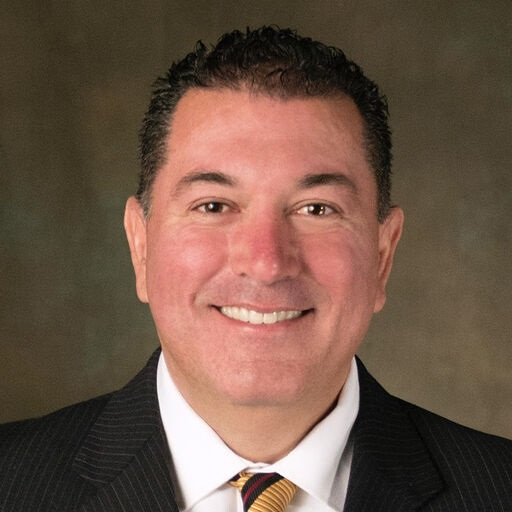
“I always emphasize the ‘Three Ts’ to our teachers—teach, teach, teach.”
"We focus on our students individually because a one-size-fits-all approach to education doesn't work, and families want public school options."
We’re a charter school that was founded in 1999 in Sacramento, California. It was established on the belief that a one-size-fits-all approach to education doesn’t work for all families. We actually work here in Northern California. We serve students and families in a nine-county region in and around Sacramento County. To put the geography into perspective, the area that we serve is actually larger than the State of Massachusetts and the State of New Jersey. It’s actually larger than Connecticut, Delaware and Rhode Island combined. We serve a large geographical area.
We serve over 7,200 students in that area. We’ll be celebrating our 25th anniversary this July. Our charter is free and open to any student who wants to come here, and we’re part of the public education system here in California. We work individually with students to help them reach their full potential and focus on individualized learning for every student. About 50 percent of our students are from low-income communities, foster youth and students who are learning English. That’s Visions.
The key to our success has been being nimble, making changes and providing programs that our students and families need. For example, one of the things that we’re going to launch next year is an online hybrid middle school. Students from whatever county will meet during the day with their teachers online in a classroom for direct instruction in their core subjects of English, math and science. We’re doing different, unique things like that, and we’re always looking to be inventive, creative and, again, nimble in what we do.
Under our charter, we actually have three distinct academies. One is a TK (Transitional Kindergarten) through 8th grade Home School Academy. We have an Independent Study Academy for students in 9th through 12th grade and a University Prep Academy, which is also for 9th through 12th grade.
For our Independent Study Academy, the majority of the students come to us very credit deficient and not on track to graduate from high school in four years. Probably about 60 percent of those students come to us in the 11th and 12th grades. Our University Prep Academy students are all geared and ready to go straight to a four-year university, and many of them also take dual enrollment community colleges while they’re in high school.
One of the great things we’re actually going to do is create our University Prep Academy. We’re actually going to make that an early college, so we’re partnering with our local community colleges, and we’re going to be launching that in the fall of 2024. As such, any student who starts in our University Prep Early College Academy in 9th grade will be able to graduate in four years with a high school diploma and an AA degree from the local community college. They’ll already have two years of college after four years of high school. As I mentioned earlier, we’re doing our online middle school program and starting a credit recovery program for our 11th and 12th graders who are really at risk of not finishing their education.
That’s a good question. Our focus on students individually and their needs makes us unique. We work with students individually, and the teachers will meet with them wherever they learn best. They could meet with them in their living room at home, in a Starbucks, in a library or a community center. Wherever the kids learn best, that’s where our teachers will go and meet with the students. We’re not bound by a classroom or a building.
We are also being creative when we look at students’ needs. For example, they said that being online, they didn’t have much socialization with other students. So, what we started two years ago was that every Thursday, we had community events where students could come together and do different activities, from art to dance to whatever it may be. They have this time to get together and socialize.
We started student-led clubs last year, and we now have over 60 clubs that offer everything from American sign language to anime to a scripting club and everything in between. We also started an athletic and sports program this year for our students. We’re always looking to be creative, know what our students want and need and kind of go from there. We really individualize our instruction. What we offer you really gives a different meaning to the phrase “going the extra mile.”
Technology is just the core of our educational model. We have what we call the Launch Pad Student Support System, which we recently trademarked as LPAD SSS. It’s a single point of entry for parents to access student records, curricula, supplies and events. It is a unique system that we developed and created here at Visions.
We also partner with major curriculum and supply vendors, such as Amazon, Staples and Lakeshore Learning, to provide services and materials to our parents. Two years ago, we also started a Student Technology Service Department here in-house with our Technology Services Team. As soon as a student enrolls in our nine-county region, they make sure that a Chromebook is out to students and shipped out with very few delays. Our students have that Chromebook in order to start here with us and be successful. All of our low-income students also get a free Wi-Fi device in order to access the Internet wherever they may be.
Those are some of the things that we do around technology, and our team has been phenomenal. Within days to a week of our students enrolling, they have a laptop that we ship out to them free of charge.
I think what comes to mind is just what we’ve built here for our students and just trying to give them access to education. Often, especially after COVID-19, our students really come to us with a lot of needs besides education. They’re really struggling with more mental health and social-emotional issues. One of the things that we’ve really done in the last three years is really focused on the social and emotional health of our students.
Over the past few years, we’ve hired additional counselors to lower their caseloads so they don’t have as many students to work with. We also established an Equity and Student Engagement Department, where we hired social workers and homeless outreach specialists to provide emotional and health support for our students.
We’ve also enhanced the support of our English Learner Program. We have some significant languages spoken here in our school, and the largest language is Spanish, followed by Russian, Ukrainian and Arabic. Those are some of the largest languages that we have here. We’re really working on how to work with students and families who are new to the US or new to learning English. We’re developing all those programs as we go and really focusing on the overall well-being of students.
The key message is that students and families need to have options in education. Our traditional school setting doesn’t work for all students, and our model doesn’t work for all students, either. As such, students have to have the option of where to go and what works best.
My oldest daughter, who’s 20, went through a traditional school setting and did very well and flourished. For my middle daughter, who was 19, traditional school didn’t work for her and wasn’t good, so she went to a non-classroom-based charter school. It’s much like what we offer here, where she went to school three days a week and then two days a week. She was able to have a job and make money, and that was her motivation. Then, my son, who’s going to be in high school next year, we’re still trying to decide what route he’s going to go, especially since he’s a competitive soccer player. We’ll see what route he takes. So, the message is to offer different options and paths for students to take because not everyone takes the same path.
Just one thing. Our students are unique and diverse. They come for many different reasons. Some students come here because they’re concerned about school safety in their regular traditional school. Many are dealing with bullying, social pressures, or mental health concerns, and they come here for something different. Also, many students come here due to physical or medical conditions, and they can’t go to school every single day, five days a week, eight hours a day.
Many students also struggle with emotional issues or have family challenges. Some may have to work a full-time job or support their families, but they can do their education here. Some students are actually very competitive athletes who need the extra time for training and travel. We have some students who are former Olympic gold medalists, and then we have those students who just need the opportunity to catch up on credits.
“I always emphasize the ‘Three Ts’ to our teachers—teach, teach, teach.”
“There are over 50 million orphans in Africa, and their potential to become leaders is immense if their suffering is alleviated.”
“The key difference here is that Kettering’s model isn’t just about learning something in theory; it’s about mastering it through practice.”
The monthly briefing for executives to stay ahead. Insights, book reviews, and the best tools — all curated and distilled into 5 minutes.
Your request has been successfully submitted. Please wait for a reply from our manager, he will contact you as soon as possible.