Subscribe to outperform
The weekly Executive Briefing: insights, books, tools, and media opportunities worth your attention — curated and distilled into 5 minutes.

You have a 15-minute talk on Thursday, no slides allowed, and someone tells you to build a memory palace. A memory palace is a route through a place you know well, with each item you need to remember placed as a vivid image at a stop along it. To recall them in order, you walk the route again.
Controlled studies back it for lists: six weeks of practice took 17 novices from about 25 words recalled out of 72 to 62. The bigger promises on the pages that rank for it hold up less well. We read 12 of those pages, logged 16 claims, and checked each against seven studies, three Roman texts and a Sherlock Holmes novel.
Of 16 claims about the memory palace that we logged across 12 popular pages on 23 November 2026, eight trace to a study or Roman text, five are overstated, two have no source and one is contradicted.
The eight that hold include the Simonides banquet story, the finding that memory champions have ordinary brains, and the six-week training result. The overstated five include “all” champions using it and National Geographic’s line that it is treating depression and PTSD. The contradicted one is Coursera’s claim that Sherlock Holmes’s mind palace comes from A Study in Scarlet, where Holmes compares the brain to an attic.
For a quick version, our guide on how to remember things quickly sets up a five-point route in advance, so at a trade show you can park commitments on it in about a minute. This is the longer audit, the kind we ran on the 19 most repeated Walt Disney quotes, where five trace to his words in a dated source from his lifetime.
A memory palace is a mental route through a building or street you know, used to hold a list in order. You place one vivid image of each item at a fixed stop along the route, then walk it again to read the items back. Psychologists call the memory palace the method of loci, from the Latin word for places.
The order lives in the route, so you never have to remember what comes next, only where you are. That is also its limit. It suits things that come in a sequence.
The memory palace technique has four steps. Pick a place you know well, such as your home or your office floor. Fix a route through it with a set number of stops. Turn each item into a striking image and leave one at each stop. Then walk the route in your mind, in order, collecting each image.
The oldest surviving manual adds rules that still read well. The Rhetorica ad Herennium, written around 90 BCE by an author nobody has identified, tells the student to mark every fifth place so the count never slips, and to pick quiet places about thirty feet apart, neither too bright nor too dim.
He tells students to make their own images in place of copying a ready-made list, and to make them striking, because we let the ordinary slip and hold on to the novel. Two of the pages we read repeat that advice without naming its source.
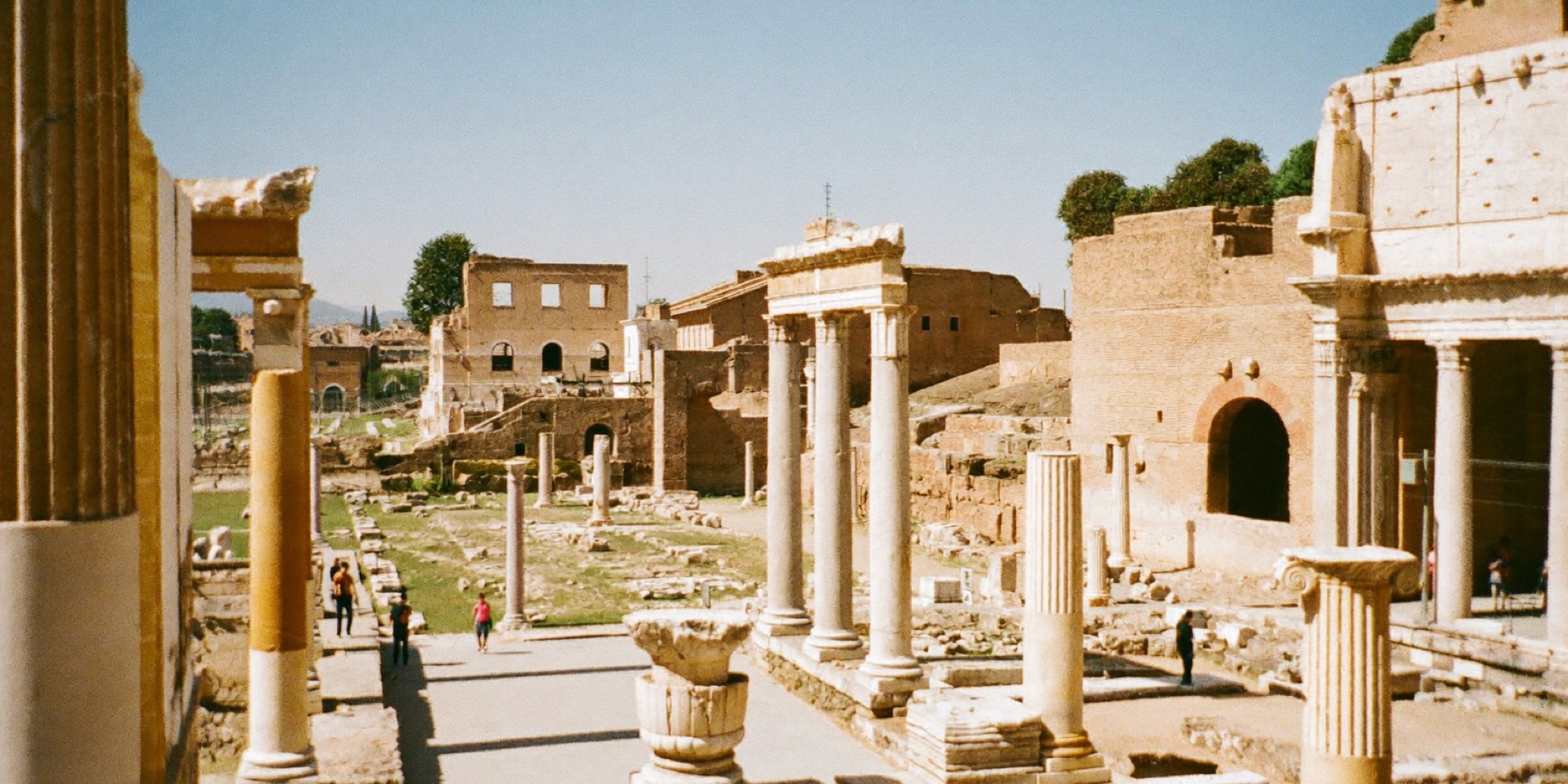
The method of loci is the scholarly name for the memory palace. Its origin story comes from Cicero’s De Oratore, written in 55 BCE. The Greek poet Simonides stepped out of a banquet just before the roof fell, and he identified the crushed guests for burial by recalling where each one had sat.
Cicero gives the story to the orator Antonius, a speaker in the dialogue, who says Simonides is said to have first invented the art and drew one lesson from the disaster: orderly arrangement is the best aid to memory. Simonides was born around 556 BCE, about five centuries before Cicero wrote.
Quintilian, writing around 95 CE, retold the story with doubts attached. In Book 11 he records great disagreement among the authorities over whom the poem honoured and whether the hall stood at Pharsalus or Crannon. He calls the part where the gods Castor and Pollux save the poet purely fictitious.
So the Simonides claim counts as traced, as a story the Romans told. The “2,500 years old” figure one guide gives rests on that story; the oldest surviving manual is about 2,100 years old.
Traced means a study or text supports the claim as worded. Overstated means a source exists and says less. Untraced means we found no source, and contradicted means the source says otherwise.
| Claim on the pages | Pages (of 12) | Status | What the source shows |
|---|---|---|---|
| Simonides invented it after a banquet hall collapsed | 6 | Traced | Cicero, De Oratore tells it as tradition; Quintilian doubted the details |
| The technique is about 2,500 years old | 1 | Overstated | Rests on the Simonides story; the oldest surviving manual dates from about 90 BCE (Wikipedia) |
| Cicero and Roman orators used it to memorise speeches | 2 | Overstated | Roman texts teach it to orators; Quintilian judged it of less use for a set speech |
| All memory championship competitors use it | 1 | Overstated | Nine of 10 superior memorisers (Maguire, 2003) |
| Most or many memory champions use it | 4 | Traced | Nine of 10 superior memorisers (Maguire, 2003) |
| Champions have ordinary brains and intelligence | 2 | Traced | No structural brain differences; comparable general ability (Maguire, 2003) |
| Anyone can learn it and improve | 4 | Traced | Novices went from 25.2 to 62.2 words of 72 in six weeks (Wagner, 2021) |
| Training reshapes brain networks | 2 | Traced | Connectivity moved toward the athletes’ pattern (Dresler, 2017) |
| The gains last for months | 2 | Traced | 50.3 words four months on, against 25.2 at the start (Wagner, 2021) |
| It is proven to improve recall | 2 | Traced | 13 randomised trials, medium effect of 0.65 (Twomey and Kroneisen, 2021) |
| You can remember (almost) anything | 3 | Overstated | Studies test word lists and personal memories; none tests a limit |
| It works with a virtual building | 2 | Traced | 141 students; virtual matched familiar; those who followed the instructions were 10 to 16% above controls (Legge, 2012) |
| It is treating depression and PTSD | 1 | Overstated | Patients with depression kept positive memories better; no significant mood change; no PTSD outcome measured (Dalgleish, 2013) |
| It creates new neurons from stem cells | 1 | Untraced | No source on the page; none of the seven studies measured new neurons |
| Sherlock’s mind palace comes from A Study in Scarlet | 1 | Contradicted | Holmes compares the brain to an attic; no palace in the chapter (Standard Ebooks) |
| Bizarre or funny images stick better | 2 | Untraced | Advice from the Ad Herennium; neither page cites a test |
Eight of 16 is close to what we find on other much-repeated subjects. Of 25 claims about the Henry Cavill workout, 13 trace to Cavill or a named trainer. Of 21 about the Brad Pitt Fight Club workout, eight have no source. Here the central claim, that the method improves recall, rests on controlled trials.
Controlled studies show the memory palace improves recall of lists. A 2021 meta-analysis of 13 randomised trials by Conal Twomey and Meike Kroneisen found a medium effect, 0.65. A 2025 review of 68 studies in the British Journal of Psychology found a large effect against plain rehearsal, though it rated the evidence low to very low in quality.
The best-known trial is Martin Dresler’s, published in Neuron in March 2017. Twenty minutes after seeing 72 words, the 17 memory athletes from the world’s top 50 who took that test recalled 70.8 on average, and their matched controls 39.9. Then 51 men with ordinary memories were split into three groups, and one trained in the method of loci for 40 sessions of 30 minutes over six weeks.
A 2021 paper in Science Advances, led by Isabella Wagner with Dresler as last author, gives the scores. The 17 men in the loci group went from 25.2 words to 62.2. A group that trained working memory went from 30.7 to 41.7, and a group that did nothing went from 28.9 to 36.4. Four months on, the loci group still recalled 50.3 words, about double its starting score.
The scans changed too. The novices’ brain networks shifted toward the athletes’ pattern, and the closer the shift, the more they remembered up to four months later. The brain-rewiring lines on the popular pages sit close to this paper.
The limits are the sample and the task. All 51 trainees were men aged around 24, and the test was a word list. Twomey and Kroneisen flagged a high risk of bias, since most trials did not report how they randomised. The 2025 review by J. Ondřej lists studies with only one or two participants among those it reviewed.
The palace is quick to build. In a 2012 study led by Eric Legge, 141 students who used a virtual building they had explored for at most five minutes recalled as well as students who used their own homes. Among students who followed the instructions, both groups were 10 to 16 percent more accurate than untrained controls.
Self-help books we have checked carry thinner files. We matched 11 of the 21 methods in Eat That Frog to research, found an outside test for seven of the 12 research claims behind Dare to Lead, and saw only four of 14 research claims in The ONE Thing hold up fully.
Most memory champions use a memory palace, though “all” goes too far. In a 2003 Nature Neuroscience study, Eleanor Maguire and colleagues tested 10 superior memorisers, people known for feats such as those at the World Memory Championships. Nine of the ten used the method of loci for some or all of the tasks.
National Geographic’s June 2025 article says of competitors at the USA Memory Championship, “They all use variations on the method of loci.” Quartz says most do. Nine in ten, in a sample of ten, supports most and falls short of all.
The champions lacked any general advantage. On tests of verbal and non-verbal ability they were comparable to normal controls, and scans showed no structural brain differences. Their edge was strategy: while memorising they used a spatial approach that engaged regions including the hippocampus.
Joshua Foer, who won the US Memory Championship in 2006, wrote the best-known account of that training, Moonwalking with Einstein, in 2011. Dresler’s numbers show how far ordinary training goes. The novices reached 62 words; the athletes in the same study managed about 71.
The biggest overreach is capacity. National Geographic’s headline promises you can remember (almost) anything, Psyche’s guide says almost anything, and Inverse reports Isabella Wagner, lead author of the 2021 study, arguing there is no limit to the type of information a palace might hold. The studies we read test word lists and personal memories; none tests a limit. Popular Science says the types of information you can store this way are limited.
The depression claim rests on a narrower study. In 2013 Tim Dalgleish and colleagues in Cambridge taught 42 adults with major depression to store 15 positive memories on a route or by rehearsal. On a surprise test a week later, the 18 route users who finished recalled 13.8 on average, the 20 rehearsers 12.4.
Depression scores fell during training, but not significantly, and no differently between groups. The study recruited people for depression and measured no PTSD outcome. A better memory for good days is a smaller result than treating depression and PTSD.
Two claims have no source. Psyche says these memory games create new neurons from neural stem cells, citing no study, and none of our seven measured new neurons. Popular Science and the Art of Memory wiki say stranger images stick better. That advice goes back to the Ad Herennium, yet neither page cites a test, and McGill’s Office for Science and Society reports studies that found no advantage for strange images over ordinary ones.
The contradicted claim is about fiction. The mind palace on television belongs to the BBC’s Sherlock, which premiered in 2010. Coursera traces it to A Study in Scarlet, Arthur Conan Doyle’s first Holmes novel. In its second chapter Holmes says that a man’s brain originally is like a little empty attic, and the word palace does not appear there.
Retellings drift toward the bigger claim. Of 20 pages explaining the Stockdale Paradox, 19 tell the story that the optimists did not make it out, and none cites the 2012 study of prisoners of war that tested optimism. Of 25 pages on Hanlon’s razor, nine trace it to its 1980 source, and two still repeat a line credited to Napoleon.
Quintilian’s warning comes first. He allowed that the method helps with a list of names in order, but judged it “of less service” for learning a set speech, because each thought needs its own invented symbol, and he doubted the speech would flow with the memory doing double work. Use the route for the order of your points, and say each point in your own words.
A talk built on a numbered list is the easiest case. Admiral William McRaven’s make your bed speech runs to ten lessons, and eight of 17 pages we checked keep all ten in his words. Ten lessons need ten stops, one parked at each.
The same goes for an argument. A board briefing on the barbell strategy, where eight of 22 pages we read gave only the bond meaning, needs three stops: one for each end and one for the mistake of putting stocks on the safe side. So does a reading list, such as the eight Robert Greene books in order, from 1998 to this month.
Numbers are hard to picture, so turn each figure into an object and park it at a stop. A pitch built on figures like those in our trace of Ashton Kutcher’s investments, 12 company bets with $8.8 million into the early six, fits on a walk of a dozen stops.
For names in a room, use the room: tie each person to the spot where you met them, as Simonides tied each guest to a seat.
Walk the route again the next morning, without notes. That is retrieval practice, and in the studies behind Make It Stick, the harder method won all seven head-to-head comparisons we traced. Our piece on the Feynman technique argued for the same test: if you can rebuild it without notes, you know it.
On 23 November 2026 our newsroom read 12 pages about the memory palace. Five came from the US top 10: Wikipedia, the Art of Memory wiki, Psyche, Stanford’s Center for Teaching and Learning and McGill’s Office for Science and Society. Seven came from named publishers in a web search that day: National Geographic, Popular Science, Coursera, Farnam Street, Quartz, Inverse and the British Psychological Society’s Research Digest.
We left out a Reddit thread and four top-10 sites whose pages we could not locate or load. We logged every factual claim on the 12 pages about where the technique comes from, who uses it and what it does, grouped claims that said the same thing, and set aside general statements that named no finding. That left 16. Stanford’s page made none of them.
Each claim was checked against seven studies, read as full papers or official summaries, and four texts: the Rhetorica ad Herennium, Cicero’s De Oratore, Quintilian’s Institutio Oratoria and A Study in Scarlet. The full dataset, with sources and supporting text for every row, is available on request.
Minutes, for a basic one. In Legge’s 2012 study, at most five minutes in a virtual building was enough to match students using their own homes. Getting fast takes longer. Dresler’s novices practised 40 sessions of 30 minutes over six weeks to more than double their scores.
The evidence is thin. The 2025 review by Ondřej counted 18 experiments with 2,421 older adults and rated that evidence very low in quality. McGill’s Office for Science and Society calls the studies in older people promising but too few and too small for confidence.
Yes. Mind palace is the term the BBC’s Sherlock uses for the method of loci. In A Study in Scarlet, the original Holmes compares the brain to an attic.
In Cicero’s telling, Simonides named the dead by recalling where each guest had sat. The trials since have tested the same move, and for lists it holds.
Written by
Editor of The Executive Insight. Writes about leadership, decision-making and the parts of building a business that nobody puts in the plan.
You leave a meeting with two pages of notes and, a week later, cannot find the one decision that mattered. Most people have the same problem, because most of us were taught to write down what we hear rather than what we need. Learning how to take notes effectively comes down to three changes: write […]
Here is how to remember things quickly when you have no time to write them down: encode at the moment of meeting by saying the name back and tying it to one concrete feature, park numbers in chunks of three or four, place commitments in a short mental route through a building you know, and […]
You were handed this book on a leadership course and never finished. The 7 habits of highly effective people summary, in one breath: be proactive, begin with the end in mind, put first things first, think win-win, seek first to understand, synergize, sharpen the saw. Three govern you, three your work with others, and one […]
The launch slipped a quarter, the board meeting went badly, and a colleague sends you two words by way of comfort: amor fati. The amor fati meaning is love of fate, wanting what happened, losses included, instead of wishing it away. The Latin phrase first […]
You have heard that Warren Buffett drinks five Cokes a day and lets the stock market pick his breakfast. Both are his own words. The Warren Buffett diet, as he tells it, is Coca-Cola, a McDonald’s breakfast, ice cream, potato sticks and steak, settled by […]

You have just been handed a team, and someone on it swears by John Maxwell. John Maxwell books number more than 100 by his own count, and five of the nine lists we counted start with The 21 Irrefutable Laws of Leadership. If you are […]
You have read the famous one, or meant to, and want to know what else is on the shelf. Dale Carnegie books number 10 by our count, from The Art of Public Speaking in 1915 to The Leader in You in 1993. Both Goodreads reader […]
You have a long flight on Friday and room in the bag for one Michael Lewis book. Michael Lewis books run to 18 titles in his own name, from Liar’s Poker in 1989 to Blockers in October 2026. Of the six lists we counted, two […]
Someone missed the deadline your quarter depended on, and the first story your mind offers is that they did it on purpose. Hanlon’s razor is the rule written for that moment: never attribute to malice what stupidity, carelessness or plain error explains. Its first known […]

You have seen the Brad Pitt Fight Club workout: chest on Monday, back on Tuesday, a 225-pound bench set, a Nautilus press and a pec deck. In nothing we read has anyone who worked on the film put a name to that routine. The one […]
You keep seeing his titles on a colleague’s desk and want to know where to begin. There are eight Robert Greene books, from The 48 Laws of Power in 1998 to The Law of the Sublime this month. Four of the seven lists we counted […]
You have five minutes to open the offsite, and someone suggests the make your bed speech. Admiral William H. McRaven gave it at the University of Texas at Austin on 17 May 2014. It is ten lessons from Navy SEAL training, and each one ends […]
Your calendar holds eleven meetings, three projects marked urgent and not one hour that belongs to any of them. Here is the one thing summary. Gary Keller and Jay Papasan argue that extraordinary results come from narrowing your work to the single task that makes […]
The weekly Executive Briefing: insights, books, tools, and media opportunities worth your attention — curated and distilled into 5 minutes.

You’re in. Your free guide to the best AI tools is on its way to your inbox, and your first issue will follow soon.
Can’t find the email? Check your Promotions or Spam folder.
Your request has been successfully submitted. Please wait for a reply from our manager, he will contact you as soon as possible.
Your copy of The Executive Insight Book Challenge List is downloading now. Enjoy the list — and while you're here, take a look at our latest interviews.