
Same saboteur, same tactics, same room. The team that held together did it with one specific, learnable habit — not luck.
Organizational researcher Will Felps ran a simple experiment: train an actor to play a Jerk, a Slacker, or a Downer, plant him inside ordinary four-person teams working through a business exercise, and watch what happens. Across 40 groups, the pattern was almost universal. His presence alone was enough to drag group performance down by 30 to 40 percent, as Daniel Coyle recounts in The Culture Code — not because the actor did the group’s work badly, but because everyone else started working differently around him. Teammates shared less, communicated less carefully, and began mirroring the same negative energy.
Read The Culture Code →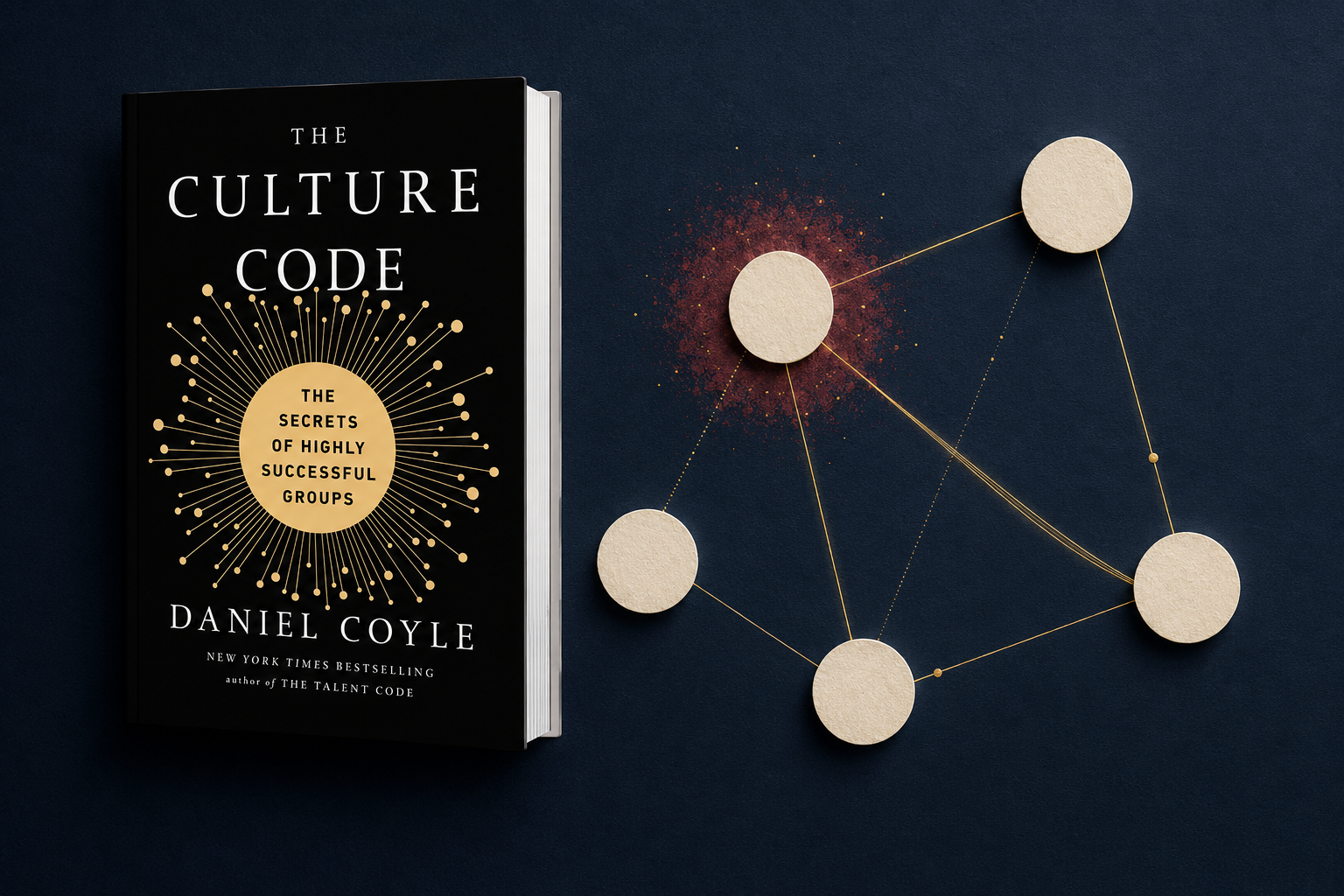 Except in one group. It didn’t collapse. Coyle credits a single team member — he calls him Jonathan — who neutralized the saboteur in real time: absorbing hostility with warmth instead of matching it, redirecting the group’s energy, and repeatedly drawing quieter people back into the conversation. Felps was curious enough about this one outlier that he studied the video frame by frame, the way a coach might break down game film. What he found wasn’t charisma or luck. It was a specific, repeatable set of moves — and that’s the detail most retellings of this experiment leave out.
That changes what the lesson actually is. It’s not just “one difficult person can sink a team,” which is a warning. It’s “a specific, observable behavior can prevent that from happening even when the saboteur doesn’t change at all,” which is something a leader can actually build toward. It also exposes a blind spot in how most companies evaluate talent, in both directions. A highly productive but corrosive employee’s individual output shows up cleanly on a performance review; the trust and effectiveness they quietly drain from everyone around them usually doesn’t. But the reverse is just as invisible: nobody’s review says “prevented three teammates from disengaging this quarter.” Jonathan’s skill is real value creation, and it’s structurally invisible to most performance systems.
Two ideas worth carrying into the boardroom: Evaluate a high performer by their effect on the team, not their individual output alone — someone who delivers strong personal results while reducing everyone else’s effectiveness may still be a net loss. And treat the Jonathan behavior as a skill to identify and develop, not a personality trait some people happen to have. If it’s a specific set of moves — absorb, redirect, include — it can be named, coached, and rewarded, rather than left to chance.
Best for: Leaders who want to understand why talented teams underperform — and how trust, safety, and shared purpose shape collective performance. Reading commitment: Around five hours, story-driven and easy to finish in a couple of sittings.
That shift — from measuring what someone produces to measuring what they do to the people around them — is exactly what Culture Amp is built around: an employee experience platform whose effectiveness surveys collect structured feedback from the people best positioned to see the cost, or the save. Its 360 templates draw from managers, peers, and direct reports at once; its Team Effectiveness survey asks a group to assess how it actually functions together, surfacing not just who’s dragging a team down but who’s quietly holding it together.
Culture Amp can’t identify the Jerk, the Slacker, or the Jonathan on a team, and it shouldn’t be used to build a case against anyone. Its surveys are designed as developmental instruments, and turning peer feedback into evidence is the fastest way to poison the well — people stop answering honestly the moment candor becomes ammunition. What it can do is make a person’s effect on the group, in either direction, visible enough to coach.
There’s also a chance to put your own thinking in front of a wider audience: this issue brings an exclusive feature placement in Fortune, arranged through TEI’s media relationships. Fortune carries real weight with investors, boards, and prospective hires — audiences that judge a leadership team by how it actually operates, not only by what it produces, which is exactly the distinction this issue is about. TEI’s team handles the interview, drafting, and placement end to end.
Interested? Talk to our team to learn more about this opportunity and discuss the details. Schedule a call through our Calendly, or simply reply to this email and we’ll be happy to assist.
Take with you: Do you know who on your team is quietly holding it together — and are you doing anything to develop more people like them?
The Executive Insight — 169 Madison Ave STE 11570, New York, NY, 10016