A profitable month and a solvent month are two different things, and only one of them is on your profit and loss statement.
The clearest measure of this comes from the JPMorgan Chase Institute, which analyzed 470 million transactions across 597,000 small businesses. The median business held 27 days of cash buffer, meaning that if money stopped coming in, it could cover its usual outgoings for 27 days. A quarter of businesses held fewer than 13 days. Restaurants sat at 16 days, retail at 18, construction at 19.

Now put that next to how long it takes to get paid. Xero’s Small Business Insights, reporting on the first quarter of 2026, found that US small businesses waited an average of 28.8 days to be paid, with invoices settled around 9 days past their due date, up from 8.4 days at the end of 2025.
Read those two numbers together and the problem is obvious. The typical small business is waiting slightly longer to be paid than it can afford to go without being paid. Every invoice that slips a week is spending someone’s buffer. And none of this shows up as a bad month on paper, because the sale was recorded when the work was done. The profit is real. It just hasn’t arrived yet.
When the squeeze comes, most owners reach for the accelerator. Chase more sales, run a promotion, take on the big project with the long payment terms. That instinct is what Mike Michalowicz wrote Fix This Next about.
His argument is that businesses rarely fail from a lack of effort. They fail from working hard on the wrong problem. He sets out a Business Hierarchy of Needs with five levels, starting with sales, then profit, then order, then impact, then legacy, and argues that you have to satisfy the lower level before the one above it is worth your attention. The job is to find what he calls the vital need, the lowest unmet need in the business, and fix that one thing before anything else.
Cash sits low in that hierarchy, which is why it quietly breaks everything above it. An owner who responds to a cash squeeze with a marketing push is working two levels up from the problem. More sales on the same terms means more work delivered before more money arrives, and the buffer gets thinner while the pipeline looks healthier. Michalowicz’s point is not that marketing is a waste. It’s that the most urgent problem and the most important one are usually different, and the important one is almost always lower down.
For an owner, that points to two changes.
Know your buffer in days, not in dollars. Take the cash you hold and divide it by what you spend in an average day. That single number tells you how long you could keep the doors open with nothing coming in, and it moves every time a client pays late. A bank balance on its own tells you almost nothing. The same balance is comfortable for a consultancy and alarming for a restaurant with payroll on Friday.
Fix the level you are actually stuck on. If the vital need is cash, then payment terms, deposits, and following up on invoices matter more this quarter than a new offer or a rebrand. Shortening terms from 30 days to 14 on new work, or asking for a deposit, changes the buffer faster than any campaign, and costs nothing to try.
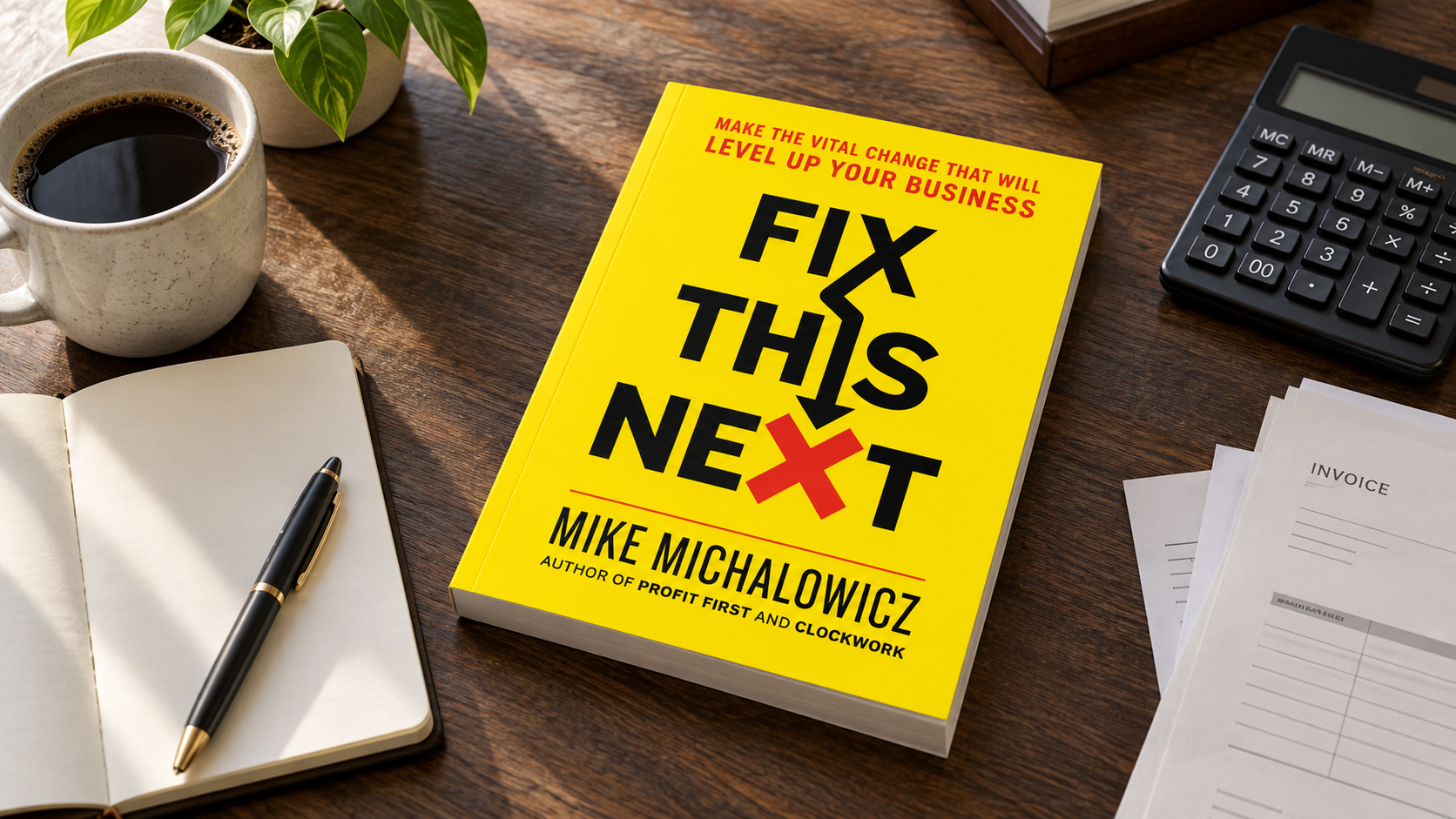
Best for: Owners who are busy and profitable and still nervous about the bank balance. Reading commitment: About five hours, structured around a diagnostic you can use the same day.
Seeing the gap early is the part most small businesses have no system for. Forecasting tools that plug into existing accounting software have gotten simpler in recent years. Instead of asking you to build a model, they read your own transaction history and project forward from it. Cash Flow Frog is one example. It connects to QuickBooks or Xero, pulls in the invoices and bills already on file, and weights its forecast by how customers have actually paid in the past rather than by their stated terms. It also lets you test a scenario before you commit to it, so you can see what a new hire, an equipment purchase, or a client on 60-day terms would do to the balance.
Tools like this have real limits. A forecast is only as current as the bookkeeping behind it, so if you reconcile once a quarter you get a confident-looking picture of old information. It projects patterns rather than events. It won’t see a major client going quiet before it happens, and it won’t chase a late invoice for you. What it can do is turn a vague worry about cash into a specific date, which is often the difference between noticing a problem and acting on it.
TEI offers a feature placement in AP News, arranged through our media relationships. AP News carries the credibility that comes with more than two hundred years of reporting, and its audience pays attention to how businesses are actually managing money right now rather than how they describe it. If you have built something durable through a tight period, that’s a story worth telling. For details, grab a time on our Calendly or reply to this email.
Take with you: If every client paid you two weeks later than usual, starting today, how long could you keep going?
The Executive Insight, 169 Madison Ave STE 11570, New York, NY, 10016