
A genomics lab doubled machine usage and cut sample processing time by 85% by changing one rule: nothing new starts until there’s room for it.
At the Broad Institute, the genomics research center run jointly by MIT and Harvard, a team responsible for processing DNA samples was falling behind. Expensive sequencing machines sat idle while backlogs piled up elsewhere in the pipeline. The team didn’t hire more people or buy faster equipment. They changed one thing: how work moved from one stage to the next. Instead of every stage pushing finished work onto the next regardless of whether that team had room for it, each stage began pulling in new work only when it actually had capacity. The usage rate of those expensive machines more than doubled. The average time to process a sample fell by more than 85%. Nothing about the science changed. Only the traffic pattern did.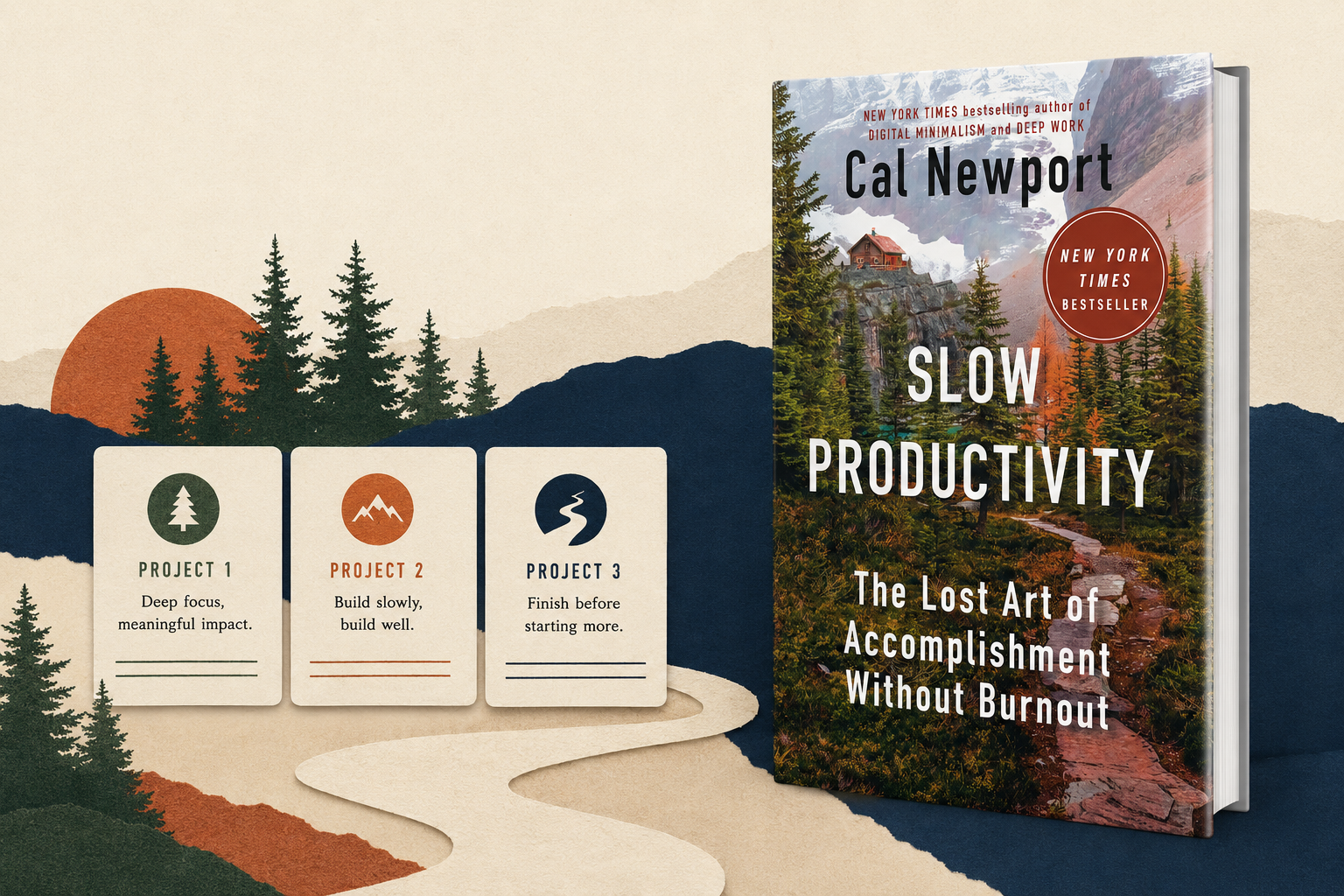 Read Slow Productivity →
Cal Newport, in Slow Productivity, calls this the difference between push and pull. Most knowledge-work teams — and most executive calendars — default to push: work lands on someone the moment it exists, whether or not they have room for it. A pull system only lets new work start when there’s genuine capacity for it, the same principle factories learned decades ago that most knowledge work has never adopted. The pattern isn’t unique to research labs, either — a well-documented software team that switched from push to pull saw on-time delivery jump from 0% to 98% within a year, without changing the underlying engineering work at all.
Push feels productive precisely because it looks responsive: work starts immediately, nothing waits, everyone appears busy. That’s exactly why it’s expensive. Every additional concurrent project doesn’t just cost its own time — it multiplies the coordination tax on everything else already in flight: status updates, context switching, meetings to figure out what’s actually blocked. Push hides this cost because on paper, everything looks fine, right up until lead times quietly balloon and nothing finishes when it was supposed to. Two ideas worth carrying into the boardroom: Cap how many things can be in flight at once — not how many hours people work, but how many initiatives are genuinely moving at the same time across a team or organization. Newport’s own version limits an individual to three active projects; the same logic scales to a department or a company. And make new work justify itself against existing capacity before it’s approved. A new initiative shouldn’t just get a budget and a start date — it should come with an honest answer to what it delays or displaces.
Best for: Leaders who want a structural fix for organizational overload, not another productivity habit. Reading commitment: About five hours, practical rather than academic.
That shift — from unlimited work-in-progress to a visible, enforced capacity limit — is exactly what Businessmap (formerly Kanbanize) is built to operationalize at the leadership level, not just on an engineering team’s board. Its Portfolio Kanban view lets executives see every active initiative across the organization in one place, set explicit limits on how many can be “in progress” company-wide, and hold new proposals against real capacity before they’re greenlit.
It won’t decide which initiatives matter most — that’s still a judgment call. But it makes the cost of adding one more thing impossible to ignore, which is the entire problem with push in the first place.
There’s also a chance to put your own thinking in front of a wider audience: this issue brings an exclusive feature placement in Business Insider, arranged through TEI’s media relationships. Business Insider carries particular weight with prospective hires and current employees — often the first place someone looks to find out whether a company actually works the way it claims to, which is exactly the gap this issue is about. TEI’s team handles the interview, drafting, and placement end to end.
Interested? Talk to our team to learn more about this opportunity and discuss the details. Schedule a call through our Calendly, or simply reply to this email and we’ll be happy to assist.
Take with you: How many things is your team currently pushing forward at once — and how many of them actually have room to be worked on right now?
The Executive Insight — 169 Madison Ave STE 11570, New York, NY, 10016