The skill that earns someone the promotion is usually the one that gets in the way once they have it.
When economists Alan Benson, Danielle Li, and Kelly Shue studied promotion decisions across 131 firms and nearly 40,000 sales workers, published in The Quarterly Journal of Economics in 2019, the pattern was consistent. A salesperson who sold twice as much as a peer was about 15% more likely to be promoted into management. But once promoted, every doubling of a manager’s past sales was linked to a 7.5% drop in how much they lifted their team’s results. The best sellers were the most likely to get the job and, on average, among the least effective at it.
Read those two findings together and the promotion stops looking like a reward. The business loses its strongest individual output on day one, then gets a manager whose team performs below what a less decorated colleague might have delivered. The researchers found one signal that did predict good managers: experience with shared, collaborative sales. Firms mostly overlooked it.
In a large company, one weak manager is a line item. In a business of fifteen people, it can be the whole sales team, with no HR department to notice the slide and no bench of other managers to absorb it. And the support gap is wide. A 2023 study by the Chartered Management Institute found 82% of people entering management had no formal management or leadership training. More recently, Gallup’s State of the Global Workplace report, released in April 2026, found manager engagement fell to 22% in 2025, down from 30% in 2023, and identified it as the main driver of the wider drop in employee engagement. Managers used to be the most engaged group at work. They are now barely ahead of the people they lead.
When a new manager struggles, it’s tempting to respond with more pressure to hit the numbers. But that pressure tends to push them further into the habit that caused the problem: competing to be the best performer on their own team. Simon Sinek’s Leaders Eat Last explains why that habit is so hard to break. The title comes from a Marine Corps custom: at mealtime, the most junior Marines eat first and the most senior eat last. Nobody orders it. It reflects what the officers understand their role to be. Sinek’s argument is that the people we follow are the ones who put the group’s needs ahead of their own, and that doing so builds what he calls a Circle of Safety, a team where people spend their energy on the work instead of protecting themselves from each other.
Sinek frames this through the chemistry of motivation. It’s a simplification of the neuroscience, but a useful one. Dopamine and endorphins reward individual achievement: hitting the target, closing the deal, finishing the task. Serotonin and oxytocin reward belonging, trust, and the pride of a group doing well together. A top performer has spent years being fed by the first pair. Management asks them to get their satisfaction from the second, and nobody tells them the rules have changed.
Sinek’s own line puts the trade plainly: “The true price of leadership is the willingness to place the needs of others above your own.” His clearest example is Bob Chapman of Barry-Wehmiller, who during the 2008 recession chose company-wide furloughs over layoffs, reasoning that “it’s better that we all suffer a little than any of us have to suffer a lot.”
For an owner, that points to two changes worth making.
Separate the reward from the role. If management is the only way to recognize your best performer, you will keep promoting people for a job they never showed they could do. Recognize top output with pay, scope, or a senior title of its own, and look for the signal the research found: who already makes the people around them better.
Judge a new manager by what the team produces, not by what they still produce themselves. A new manager who keeps closing the biggest deals is not succeeding. They are still an individual contributor with a bigger title. The job Sinek describes, taking the pressure so the team can do its best work, rarely shows up on the manager’s own scoreboard. That’s exactly why it has to be measured on the team’s.
Read Leaders Eat Last → 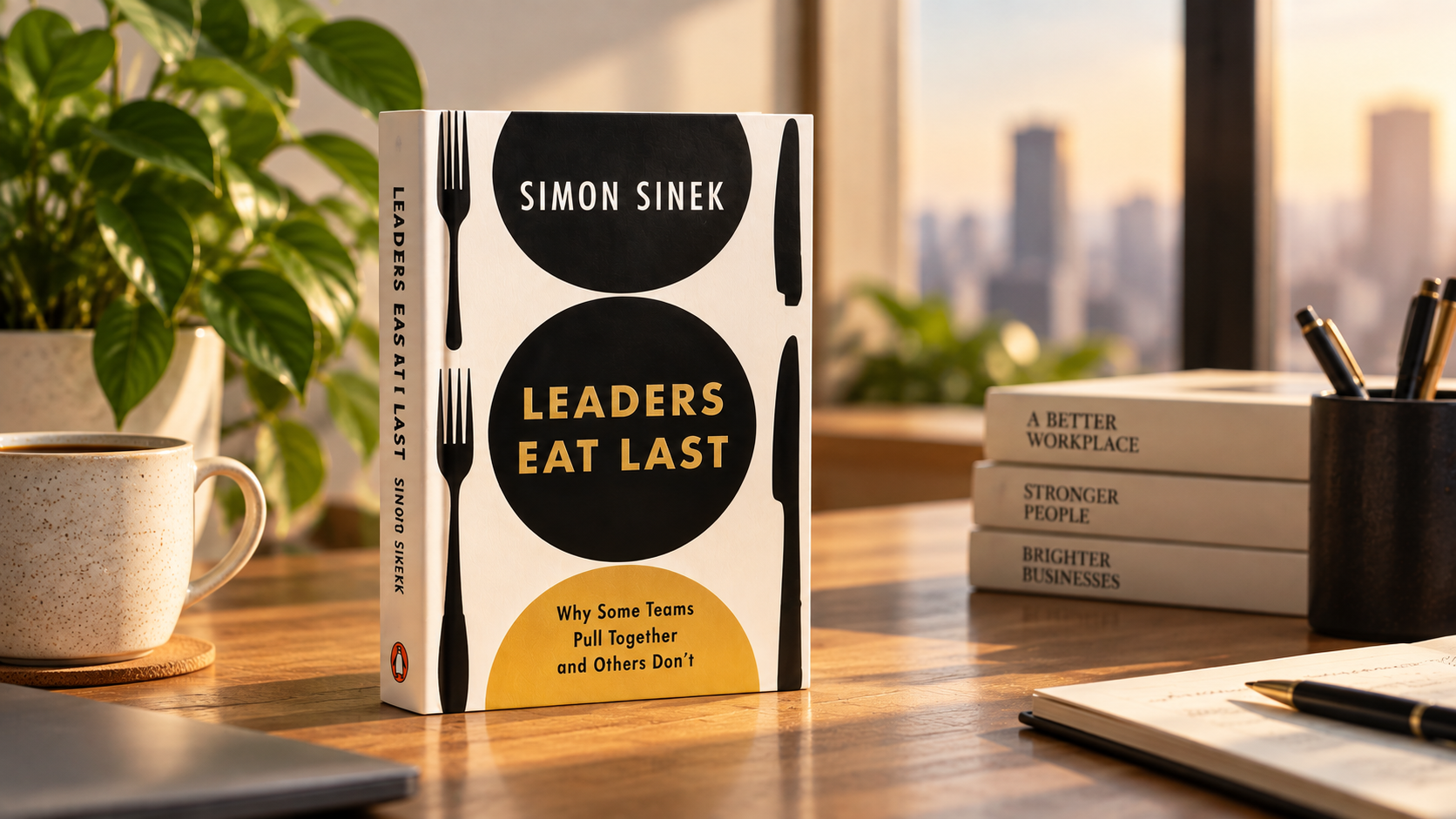 Best for: Owners who have promoted a strong performer and want a shared language for what the new role actually demands. Reading commitment: About seven hours, story-driven, with enough science to make the argument stick.
Understanding that the job has changed is one thing. Acting on it at 4pm, when a deadline is slipping and it would be faster to just do the work yourself, is another. That gap is where Bunch is useful. It’s an AI leadership coach designed for first-time managers and growing startup teams. A new manager takes a short leadership assessment, then gets a two-minute daily tip and scenario matched to the skills they need most, with an AI coach available around the clock for the situation in front of them: how to open a hard conversation, how to delegate something they would rather do themselves, how to respond when a team member pushes back. For a small business with no training budget or HR function, it puts manager development within reach at the price of a subscription rather than a program.
It has real limits. An AI coach knows management in general, not your people, your customers, or the history behind a particular conflict, and its advice is only as good as the context a manager gives it. Short daily tips build awareness more easily than they build habits, so it works best alongside regular check-ins with you, not as a replacement for them. Pricing is published for individuals, while team plans require contacting the company. But if you just promoted your best person and there’s no one else to coach them, it’s a practical first layer of support.
The owners who get this right often have the most useful stories to tell, and we’d like to help share them. Through TEI’s media relationships, we have an opening for a feature in Fortune, whose readers pay close attention to how companies develop the people who run them. If you’ve rethought how you promote, built managers from within, or learned the hard way what this issue describes, reply with a few lines about your experience or grab a time here. TEI’s team handles the interview, drafting, and placement from start to finish.
Take with you: When you last promoted someone, were you rewarding what they had done, or choosing who could do the next job?
The Executive Insight, 169 Madison Ave STE 11570, New York, NY, 10016