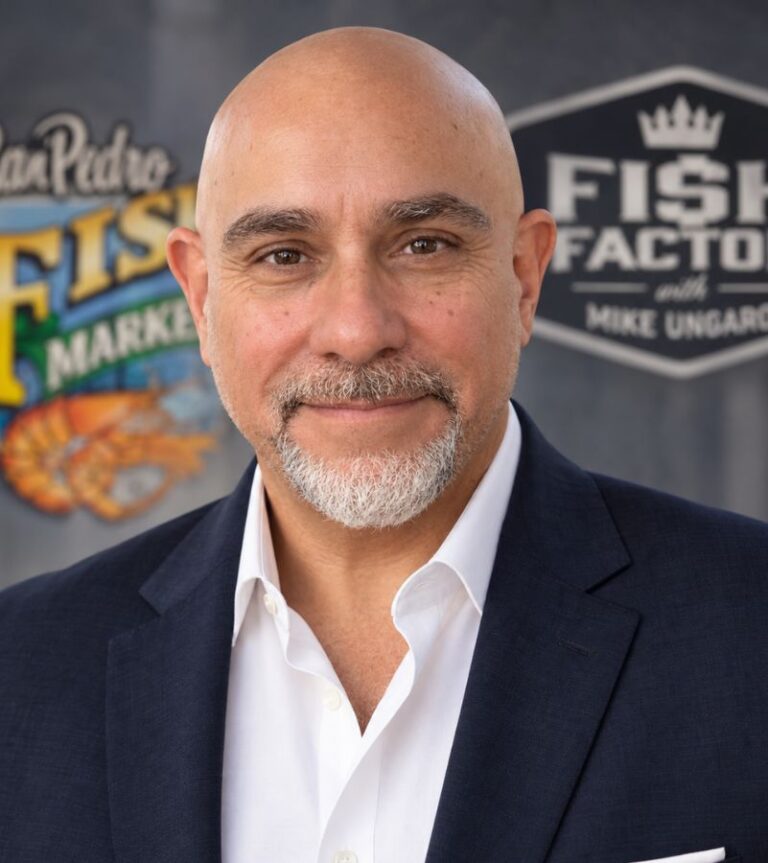
"If you don’t tell your story, someone else is going to tell it for you, and they’re probably going to get it wrong."

Could you give us a brief overview of your business before we dive in?

San Pedro Fish Market was founded by my grandfather 70 years ago. It started as a small, 200-square-foot corner store selling seafood to locals, literally out of ice chests. Over the years, it moved down to the waterfront and grew into one of the largest restaurants in the country, with 3,000 seats across 55,000 square feet, serving close to 2 million customers annually and about 200 tons of shrimp — our top seller. Customers come in, pick out their seafood, and we cook it for them; it’s mostly family style.

We’ve set four Guinness World Records doing that, and we were one of the top 10 most Instagrammed restaurants in the world three years running, back when Instagram used to measure that. We also self-produce our own television series, Kings of Fish, available on YouTube, with a new season currently streaming on Amazon Prime.

What makes Kings of Fish different from other food and entertainment brands? Can you tell us more about this?

Kings of Fish is our reality series, and what sets it apart, I’d say, is that it tells the story of what it took to build a family-owned and operated brand over 70 years, along with the accomplishments I mentioned earlier. Really, it’s about storytelling. I think that’s what sets us apart — a lot of legacy businesses stay heads-down and labor-focused, which is fine, but I noticed that during a 13-year stretch, our sales grew only modestly, from $7 million to $10 million annually — less than 3% growth, averaging about 2.5–2.8% a year.

When I got involved on the storytelling side of the business — trademarking our intellectual property, using social media to share the stories of the business, our employees, and our accomplishments — we started seeing double-digit growth. We averaged about 17% annual growth for seven years, right up to the pandemic.

The value in that became clear when we faced two major obstacles. One was the pandemic. But even before that, there was a major push to redevelop the Los Angeles waterfront, which is our home, and we weren’t guaranteed a place in that redevelopment. So after 50-plus years, our future was in question — and not for the first time. The waterfront had been redeveloped once before, in the late ’70s, forcing us to leave our building and operate out of a parking lot for about a year and a half until we could rebuild.

Watching that threat resurface about four years ago was a real concern. But the storytelling we’d done through Kings of Fish and social media had built so much brand equity that we became one of the top 10 highest-grossing independent restaurants in the country. We leveraged that in two ways: it helped us get through the pandemic — having most of our seating outdoors helped, but so did the brand value we’d built — and we bounced back quickly despite a dip in sales.

Then, right as the pandemic ended, we got the eviction notice to move out of our location. Because we’d built such a strong identity, revenue base, vendor network, and market presence, we were able to leverage that to reopen quickly. We left the building on March 3rd and, by Cinco de Mayo — about 60 days later — had opened a pop-up location with 900 seats, down from 3,000. We were still doing well; if it hadn’t been for unseasonal rain in California, our run rate out of that parking lot would have hit close to $15–16 million, which is almost unheard of. Even so, we did $11 million there.

We operated that way for two to three years before opening a more substantial temporary location, built out of shipping containers, with close to 2,000 seats. It took longer to open than expected, but this year it’s on track to do over $20 million — significant for a temporary spot — and it’s still the same products we’re known for.

What has been the biggest challenge in turning a family business into a media brand?

It’s a constant struggle for me personally. I love my family, but they tend to be more tactical and labor-focused — tell me what to do, and let me do it. A media brand isn’t something you can hold in your hand the way you can a loaf of garlic bread or a plate of shrimp, so because it’s more abstract, there’s an ongoing internal debate about whether it’s worthwhile.

To me, there’s no question — it’s probably the most innovative marketing I’ve done, and it’s unusual in the industry. I’ve done some public speaking at various events, and people are often surprised by what we’ve been able to produce.

Here’s an example: our first season was built for social media — four-minute episodes released mostly on Facebook, starting at the end of June 2016. The four episodes ran weekly through July, which we’d always considered our busiest month. We couldn’t imagine producing more revenue than we already were — but right when the show launched, we saw a 33% jump in sales, when we hadn’t thought even a 1% increase was possible. That settled the case for me. It’s been valuable strategically ever since — for negotiations, economically, politically, and even in technology partnerships.

What’s harder to quantify is whether the people watching actually come into the restaurant, since it’s online and anyone in the world can watch. After our first four episodes, we partnered with a company called Foodbeast. They were building their own content library and had over a million followers at the time. We offered them all four episodes in exchange for exposure on their social channels, but they felt they were getting the short end of the deal, so they came down and filmed their own content on-site.

They produced a video called “The Super Tray,” which went viral — over 55 million views. It went live in March 2017 and, within the first 10 days, brought in 30,000 customers. The reach was like nothing we’d seen before. It proved to me that social media can be a huge asset, and storytelling deepens that because it gives people something to connect to.

What opportunities do you see in food-focused entertainment — what do you think you can do next?

I also have a podcast, Fish Factor with Mike Ungaro, that I ran for about a year and currently have on pause — we’re planning to pivot it toward exactly this. It was originally designed to fill the gap between seasons with B2B-focused content, and what I’ve realized is that there’s a story along every part of the restaurant industry’s supply chain.

For example, we work with a company called Sunrise Produce, and the more I’ve gotten to know its owner, the more evident it’s become that they’re dealing with real struggles around the economy and the weather — stories that go untold. You go to a restaurant, eat something, and take for granted that there’s a story behind every ingredient and the whole supply chain behind it.

In seafood specifically, I’ll be working with a company called Mowi — the largest producer of farmed salmon in the world. I met them at the National Restaurant Association Show in Chicago in May. They already tell their story, but it’s consumer-facing — educating people on the health benefits of the product and where to find it. What they’ve struggled with is the B2B side: they’d like to show the salmon’s journey from the water to the chef’s plate, and those stories aren’t being told. As a result, restaurants often order salmon through distributors like US Foods or Sysco without knowing the brand — seafood doesn’t have many well-known, requested brands. So we’re going to help tell that story, so chefs specifically want Mowi’s salmon rather than just any salmon.

What’s the main lesson you would share with other family businesses?

One of the biggest lessons — especially for multi-generational family businesses — is the importance of separating operator from owner. Many of us are raised in these businesses doing everything ourselves, which works up to a point, but most family businesses don’t make it past the third generation; they tend to fall apart by the fourth.

If you can’t separate your identity from the business and let someone else come in to help run it and teach you — especially as the world changes so quickly and the way we did things 20 years ago doesn’t work as well now — you have to be willing to pivot, stay aware of technology, and be humble enough to step aside. When people can’t do that and let their ego get in the way, the business can suffer and fail, often faster than they realize.

Find people who are better at things than you are, and get out of the way. Sometimes when I bring people in, there’s this narrative of “are you saying I’m stupid, that I don’t know what I’m doing?” And I always say no — I’m trying to make us all smarter.

Latest From The Executive Insight

  • Wealth

    The offer email arrives. The number is fine, maybe slightly less than you hoped, and the recruiter is waiting for an answer. Most people say yes. Knowing how to negotiate salary at this exact point is worth more than at any other moment in the […]

    8 min read
  • Mindset

    The busiest office workers are interrupted every two minutes during core hours. That figure comes from Microsoft’s own data on how people use its software, and anyone who runs a team will recognise it. Most productivity hacks are written for a calendar you control. The […]

    8 min read
  • Wellness

    The alarm goes off at six. You hit snooze twice, get up at half past, and spend the first hour of the day feeling like someone else is driving. Most advice on how to become a morning person starts with the alarm: set it earlier […]

    9 min read
  • Business

    A project lands that your team cannot carry. The product launch is in four months, the two engineers you need do not exist on your payroll, and a permanent hire will take most of that time just to find. Staff augmentation is the usual answer: […]

    10 min read
  • Lifestyle

    Most people meet Alex Hormozi through a video clip: a muscular man in a T-shirt explaining, with some impatience, why your business is not making money. The books are better than the clips. Alex Hormozi books are short, blunt manuals on three problems every business […]

    9 min read
  • Editorial

    Most of the decisions that shape a company are made on an ordinary afternoon, between two other meetings, by someone who is slightly tired. Decision making in business mostly happens in small moments: a yes sent from a phone, a hire approved because the role […]

    9 min read
  • Education

    It is a Sunday evening and you are dreading the morning again. Not the workload, which you can handle, but the sameness of it. You have been good at this job for fifteen years and you can picture the next fifteen with no surprises in […]

    9 min read
  • Wealth

    The email from HR arrives on a Friday afternoon. Your last day is in three weeks, and in the attachment there is a line about what happens to your 401k. Within a day, somebody in your network has suggested an advisor who can “help with […]

    9 min read
  • Mindset

    The biggest client calls at nine on a Monday to say they are leaving. By ten, two things need to happen. Someone has to work out what the lost revenue does to payroll, which projects pause and who tells the team what. And someone has […]

    11 min read
  • Wellness

    You open a document to write one paragraph. Four minutes later you are reading an email you did not need to read, with two new tabs open and the paragraph unwritten. If that sounds like most of your working day, you are in good company, […]

    8 min read