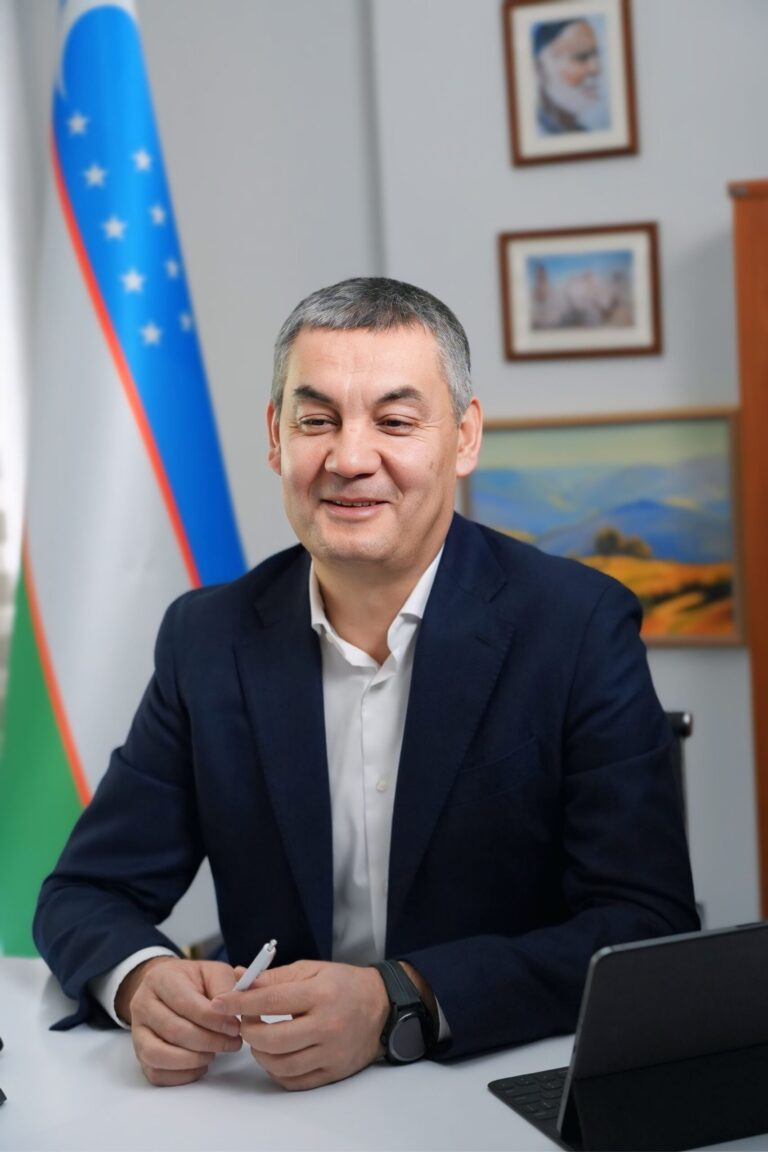
"Equipment can be purchased. Strong specialists and a strong production culture take years to build."

How does controlling production from cotton to garments give Global Textile an advantage with international buyers?

The biggest advantage of vertical integration is the combination of speed, quality, resilience and coordination across the whole production chain.

When all the key stages are within one group, decisions can be made much faster. If a customer wants to change the yarn specifications, fabric weight or hand feel, colour, finishing, or details of the final garment, we do not need to coordinate with several unrelated suppliers. Our teams are working within the same system and can solve the issue together.

It also gives us much better control over quality. If something starts to move outside the required parameters, we can identify where it happened and deal with the cause at that stage, rather than discovering the problem only in the finished product.

The model also makes the supply chain more resilient. We are less dependent on outside suppliers at critical stages, we have better control over lead times, and we can respond more quickly when demand changes.

For an international buyer, that translates into faster decisions, more consistent quality, greater transparency and one partner taking responsibility for the whole result.

How does Global Textile make its cotton traceability clear and trustworthy for customers?

Global Textile manages around 75,000 hectares of agricultural land — roughly the equivalent of 105,000 football fields. All of these fields are digitalised.

That is where traceability starts. We use satellite monitoring, GPS tracking of machinery, digital field maps and systems that record production operations. This gives us a clear picture of where the raw material comes from and what has happened to it from the growing stage onwards.

The cluster model then becomes a major advantage. After harvesting, the cotton moves through companies within the same group: ginning, yarn production, knitting, dyeing and finally garment production.

There is control and data at each stage. The raw material does not disappear into a chain of unrelated suppliers.

For us, traceability means being able to follow the product backwards — from the finished garment to the fabric, the yarn, the cotton and the relevant production stage.

The cluster model is what allows us to keep that connection throughout the chain.

What production improvement has delivered the greatest reduction in waste or resource use?

There is a simple principle: “What you cannot measure, you cannot manage.” That was one of the ideas behind the large-scale digitalisation of our operations.

If you want to improve efficiency, you first need to see the process in data: how many resources are being used, how equipment is performing, where deviations appear, where unnecessary costs arise, and where you can intervene earlier.

Today we use satellite monitoring, GPS tracking of machinery, digital management systems and analytics. In agriculture, this has already helped us reduce water use by around 25%, while the use of fertilisers and crop protection products has fallen by about 20%.

At the same time, we are already introducing artificial intelligence into our processes to work with data more precisely and make decisions faster. AI allows us to analyse much larger volumes of information, forecast outcomes more accurately and identify deviations earlier.

We see this as one of the biggest opportunities for further efficiency gains. The earlier a system detects a potential problem, the lower the risk of defects, wasted raw materials, unnecessary energy or chemical use, or lost time.

That is where we see the future of manufacturing: fewer decisions based on assumptions, and more based on accurate data and better forecasting.

What is the hardest part of maintaining consistent quality across your entire production chain?

The hardest part is people.

You can buy the latest equipment, advanced technology and good control systems, but the result still depends on the person who understands the process, sets the equipment correctly, sees when something is going wrong and knows how to respond.

And our production chain requires very different kinds of expertise. Agronomists, spinning technologists, knitting and dyeing specialists, quality teams and garment professionals all have an impact on the final product.

This becomes especially clear at the final stage. Garment manufacturing is still, to a large extent, a people business. Experience, discipline, training, organisation and a strong quality culture matter enormously.

That is why we invest so much in developing our teams. Equipment can be purchased. Strong specialists and a strong production culture take years to build.

For me, people remain the most important factor behind consistent quality.

Which international market offers Global Textile the strongest opportunity for future growth?

Western Europe and North America are especially important markets for us.

They are large, mature consumer markets where buyers have high expectations around quality, traceability, compliance, responsible production and supply-chain reliability. These are exactly the areas where our model can be very competitive.

We can offer an international brand an integrated production chain, from our own cotton through to the finished garment. That gives the customer greater transparency, control and flexibility.

We also see international companies looking more closely at sourcing diversification and at new, reliable production regions. Central Asia is still underrepresented on the global sourcing map compared with what the region is actually capable of.

Our task is to help change that perception and show that Uzbekistan can be a serious manufacturing base for international brands.

What common belief about textile manufacturing has Global Textile’s experience proven wrong?

One of the most persistent perceptions is actually about Uzbekistan itself.

Internationally, the country is still often seen mainly as a cotton producer and a supplier of raw materials. That view is becoming increasingly outdated.

Cotton remains a major advantage for us because we have our own raw-material base. But today there is also a complete production chain within the country.

At Global Textile, that chain starts in the field and continues through ginning, yarn production, knitting, dyeing and garment manufacturing.

So Uzbekistan can now offer the international market much more than raw material.

For our industry, the next step is for global brands to start seeing the country as a modern sourcing destination for finished products. I believe that perception will change significantly over the next few years.

Latest From The Executive Insight

  • Wellness

    A sleep schedule rarely breaks all at once. A deadline keeps you up until one, a flight lands late, the weekend runs long, and by Monday your body wants to sleep at 2am and wake at ten while your calendar starts at eight. Here is […]

    9 min read
  • Business

    Most consulting rates are set by guessing. Someone asks what you charge, you name a number that feels brave but not ridiculous, and that number quietly decides your income for the next two years. There is a better way. Work out what your year has […]

    9 min read
  • Lifestyle

    Most personal development books get read once, enjoyed and forgotten by the following quarter. A few are worth a second read, because they change what you do on an ordinary Monday rather than how you feel on a Sunday afternoon. The ten below pass that […]

    9 min read
  • Education

    You ask an AI for a statistic and it hands you one, with a footnote. You click the footnote and the number is not on the page. That is where the Perplexity vs ChatGPT choice really begins. Perplexity is built to find sources and put […]

    9 min read
  • Wealth

    The first meeting usually goes pleasantly. The office is warm, the adviser is good company, and by the end you have talked about your children, your plans for retirement and the house you might sell one day. What you have rarely done is ask the […]

    8 min read
  • Mindset

    You have two offers on the table, or two candidates, or two ways to spend the next year, and you have been going round in circles for a week. What you are looking for is a decision making framework, something that turns the loop into […]

    9 min read
  • Wellness

    The first week of the holiday goes well. You sleep ten hours a night, read a novel for the first time in a year, and start to feel like yourself. Then, somewhere around the Sunday before you fly home, the dread comes back. Two weeks […]

    9 min read
  • Editorial

    Most advice on how to manage stress at work treats stress as a personal failing: breathe better, sleep more, download an app. Those help at the edges. They leave untouched the thing that makes work stressful for most people, which is having a lot asked […]

    8 min read
  • Business

    Most people asking how to become a consultant already have the hard part: years of doing something well inside a company. What they lack is a way to sell it. Consulting is a business built on a narrow promise, and the people who struggle usually […]

    8 min read
  • Lifestyle

    Is an online MBA worth it? For a working professional who wants the knowledge and the credential without giving up a salary, it can be one of the better deals in higher education. For someone who wants to change careers, it is often the weaker […]

    8 min read