Subscribe to outperform
The weekly Executive Briefing: insights, books, tools, and media opportunities worth your attention — curated and distilled into 5 minutes.



Tallinn’s Old Town currently offers more than 315 separate tours. That is hardly surprising. It is one of Europe’s best-preserved medieval urban centres, compact enough to explore on foot and dense with the kind of history that lends itself naturally to guided storytelling.
It also means that simply knowing the history is not enough to stand out.
Tales of Reval took a different approach from the outset. Rather than treating the guided tour as a walk focused around historical information, the Tallinn-based company built its tours around the idea of live performance: part storytelling, part street theatre, and part audience participation.
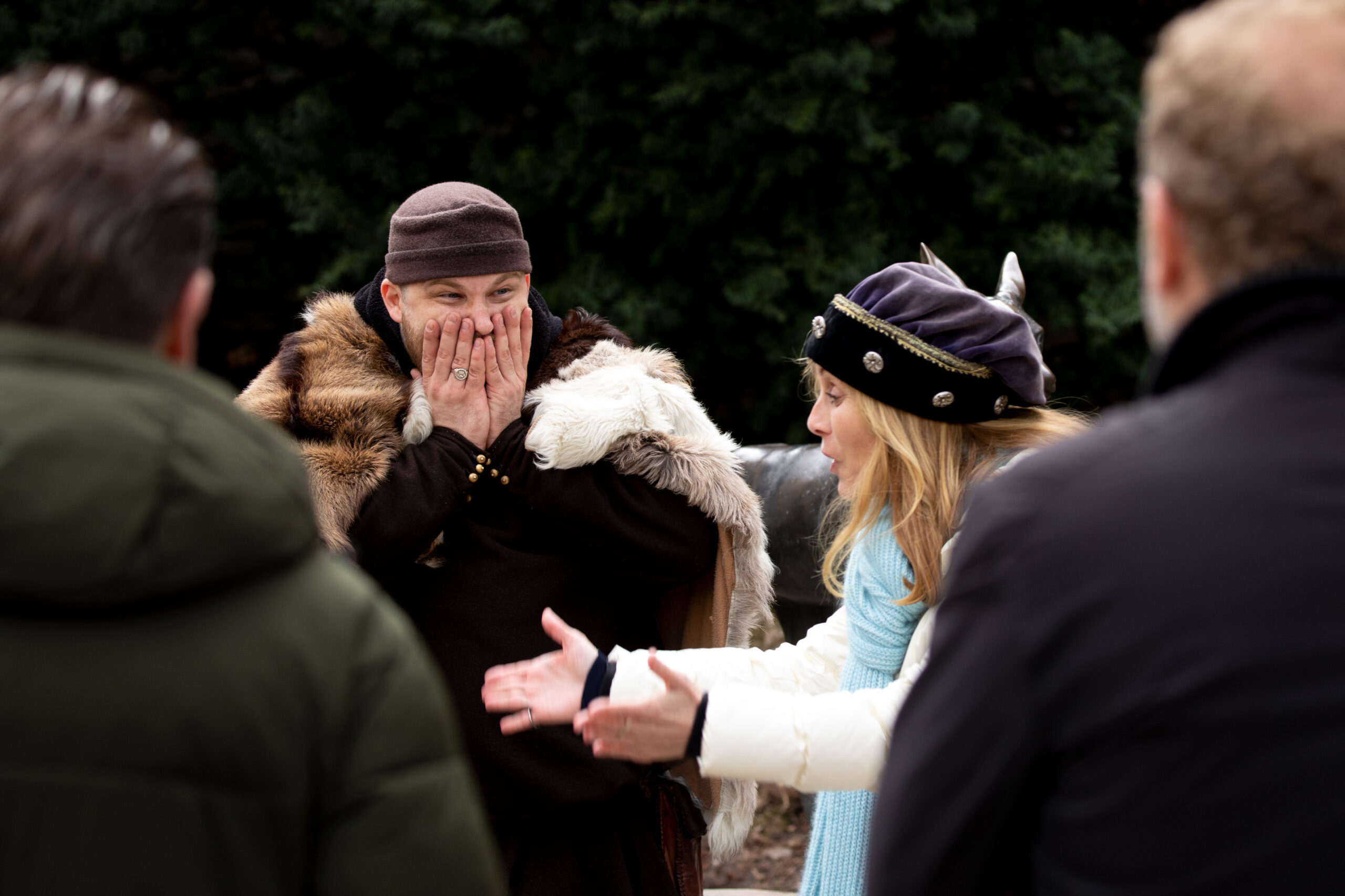
Within its first year of operation, Tales of Reval reached the top of TripAdvisor’s Tallinn tour rankings. By its second year, it was listed as the second-highest-rated experience in the city, behind only Tallinn Old Town itself.
The setting had not changed. The format had.
“Tales of Reval was born from an inspiration to reinvent the guided tour experience,” says the company’s co-founder. “Our breakthrough came when we managed to fuse elements of street performance and classical storytelling to a route in the Old Town. What made us stand out immediately was how we involved the audience in the telling of our stories—instead of a passive monologue, the crowd would actively participate via volunteering in light roles and general crowd work.”
A Tales of Reval guide is expected to know the history, but historical knowledge alone is not enough. The guide is also performing stories, reading an audience, managing a crowd and improvising around whatever happens in the street.
There is structure and there are stories to tell, but the conditions are never scripted. Weather changes. Delivery vans arrive. Church bells ring. Tour groups cross paths. Members of the public stop to watch. Someone in the audience says something unexpected.
The guide has to absorb and work with all of it. Everything that happens becomes part of the show.
That attention to detail extends beyond the performance itself. The company’s costumes are handmade by the only person in Estonia holding a doctorate in medieval fashion. Historical accuracy is treated as part of the experience rather than scenery around it.
The result is a format that has proved unusually difficult to scale.
“The greatest limitation to Tales of Reval’s growth is the human resource,” the co-founder says. “Finding someone capable of delivering that kind of experience consistently is extraordinarily difficult. A conventional guide can learn information; what we require is charisma, presence, timing, and the ability to transform the unpredictability of the street into part of the story itself. That is the single biggest natural limit to how quickly the company can grow.”
Demand can be increased through marketing. Routes can be designed. Costumes can be made. Historical material can be researched and taught.
The person standing in front of the audience is significantly harder to reproduce.
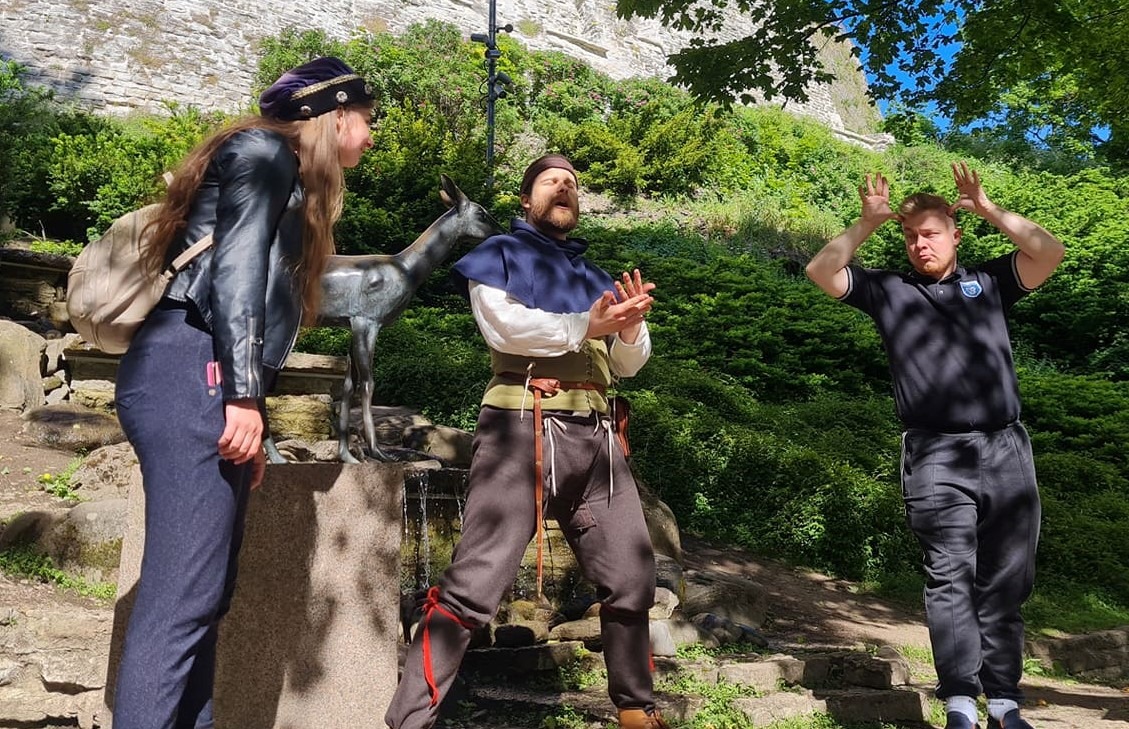
That limitation has shaped the way Tales of Reval has grown. The obvious route for a successful tourism concept would have been replication: take the format to another historic city, train another team, and repeat. Tales of Reval went in the opposite direction. It remained rooted in Tallinn and began expanding the kinds of experiences it could create there.
That development was helped by Estonia’s tourism sector. The national Tourism Board and major travel agencies began involving Tales of Reval in programmes introducing Tallinn to foreign travel agents and journalists, giving the young company early exposure to international tourism professionals and a broader range of clients.
The original walking tours gradually led to private events, destination management, bespoke experiences and themed weddings. The performance principles remained recognisable, but the canvas became larger.
In that sense, Tales of Reval has expanded. It has simply expanded in depth rather than breadth.
There is a practical reason Tallinn has remained at the centre of that development. The stories belong to particular streets, buildings and historical events. The characters and costumes make sense because of the city around them. A medieval merchant standing beneath Tallinn’s surviving town walls is not simply performing against an attractive backdrop; the physical city is supplying part of the story.
That relationship with a place is much harder to export than the visible mechanics of the tour.
A costume can be reproduced. Audience participation can be written into a script. Historical material can be researched elsewhere. But copying those ingredients would not reproduce the relationship between performer, story and city that has developed in Tallinn over years of live performances.
Guests occasionally tell Tales of Reval that the experience has “ruined” conventional tours for them—that later guided experiences have struggled to hold their attention in quite the same way.
It is a flattering exaggeration, perhaps, but it also says something about what the company has spent years building.
Tales of Reval began with an attempt to reinvent the guided tour. What emerged was something harder to separate into its individual parts: historical interpretation, theatre and improvisation, all shaped by the streets in which they are performed.
That may also explain why the company has never been particularly interested in finding a formula for reproducing Tales of Reval somewhere else.
Tallinn is not where the format happens to be performed.
Tallinn is part of the format.
Learn more about Tales of Reval at talesofreval.ee

Following the commercial rollout of its autonomous field robot, Solix, the agricultural technology company argues that reactive farming should give way to AI systems that live permanently in the field. Following the expanded commercial availability of its autonomous field robot, Solix, agricultural technology company Solinftec is calling for a fundamental shift in how artificial intelligence […]

During Discover Africa writer Thaakiera Ackerdien’s recent trip to Zambia’s Lower Zambezi National Park, morning light broke over the river in liquid gold as riverine birds lifted off the banks in sudden, synchronised arcs. A solitary elephant stood knee-deep in the water nearby, browsing the low-hanging branches of a winterthorn — an ordinary scene in […]

Formally established in 1909, with roots going back to 1903, the California Society of CPAs (CalCPA) has evolved into a powerhouse community with over 40,000 visionaries, making it the largest state society of change-makers in the U.S. accounting scene.
The weekly Executive Briefing: insights, books, tools, and media opportunities worth your attention — curated and distilled into 5 minutes.

Welcome to The Executive Insight. Your free AI guide to the best tools is on its way. The first issue arrives soon. Check your promotions tab if it is not in your inbox!
Your request has been successfully submitted. Please wait for a reply from our manager, he will contact you as soon as possible.
Your copy of The Executive Insight Book Challenge List is downloading now. Enjoy the list — and while you're here, take a look at our latest interviews.