"Wildness, fiercely defended, can always find its way home."

What drew you to Zimbabwe’s Matusadona National Park for this story, and what did you witness there?

I was on the ground in Matusadona National Park for Discover Africa Safaris as African Parks completed a rare translocation: 17 black rhinos, the first wild rhinos in the park in over a decade, now living inside a 175-square-kilometer protected zone that’s set to expand to 650 square kilometers.

While our safari cruiser was making its way along the rutted tracks toward Jenge Camp, our guide, Spike, stopped the vehicle. He’d noticed fresh footprints in the road — rounded, three-toed, pressed into the red sandy soil. Rhino tracks.

It was a striking find: the park hadn’t recorded a confirmed wild rhino sighting in this area in nearly a decade. Spike radioed park management to investigate, weighing two possibilities: an undetected survivor, or one of the black rhinos African Parks had recently translocated to the area. The answer came back quickly. A female black rhino, translocated just days earlier, had escaped its boma and was now moving through the park on its own.

Can you describe the encounter with the escaped rhino, and what that moment revealed?

We followed the prints off the road into the bush, where staff soon waved us ahead — they’d found her. A few meters away, in the tangled shadows, stood the escapee: the first black rhino to walk free on Matusadona soil in over ten years.

As my eyes adjusted to her massive grey form, she sank onto her belly, legs tucked beneath her like a cat curled up on a couch. The impression wasn’t danger. It was profound exhaustion — hardly a surprise, after 72 hours spent darted, blindfolded, crated, flown across the country, and woken in an alien landscape surrounded by strangers.

What’s the history behind Matusadona’s rhino population, and how did African Parks bring them back?

To understand how she ended up there requires looking back three decades, when the Middle Zambezi Valley was one of Africa’s premier black rhino strongholds, before poaching gutted the population. Park manager Mike Pelham remembers it firsthand.

“By 1993, we had 16 rhinos left in the park,” Pelham recalled. “We went to a project called Operation Stronghold, moving out some of these genetics from this area to safeguard them, because at that stage, that poaching wave was so hectic that we thought we were going to lose the whole Zambezi Valley genetics altogether.”

By 2016, the wild black rhino had vanished from Matusadona entirely. African Parks signed a co-management agreement with Zimbabwe’s parks authority in 2019, then spent five years rebuilding security before any rhino could return.

Moving wild-caught rhinos over the country’s degraded roads risked a fatal muscle condition, so Pelham — part park manager, part conservation engineer — designed smaller crates, “moon buggies,” to fly two rhinos at a time directly into the park.

“We had to fly them by aeroplane, because the roads in the country are in a bit of a terrible state and you get something called ‘muscle myopathy’ within black rhinos if they sit in crates and are being knocked around for too long. The muscles actually just die on them — and then the animals have to be euthanised,” Pelham explained.

Several of the 17 descend from animals evacuated during Operation Stronghold three decades ago. Pelham called their return one of the most emotional moments of his career.

What did you see when you visited the holding bomas, and what protections are in place for the newly translocated rhinos?

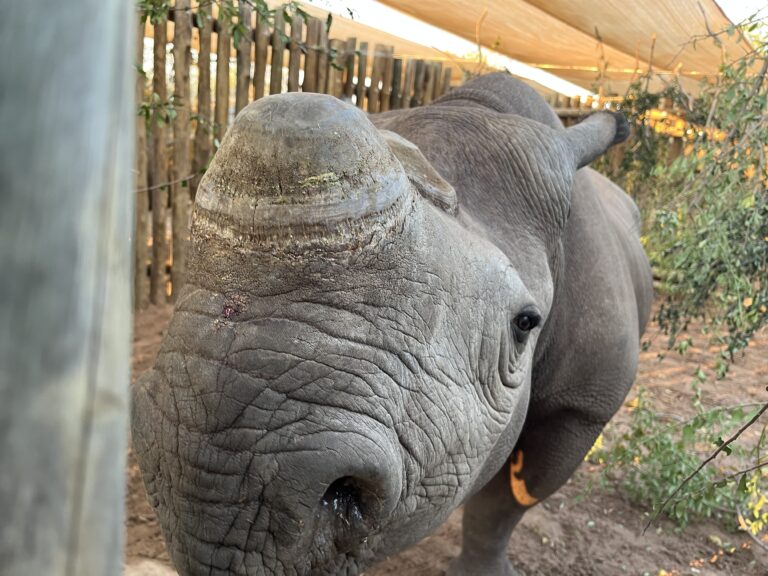
A day before meeting the escapee, I’d visited the holding bomas at Tashinga, where the newly arrived rhinos were acclimating before release. Up close, the intimidation of standing beside a two-tonne prehistoric mammal gave way to wonder as the rhinos ambled to the fence line, curious rather than defensive.

Acclimating wild rhinos calls for the opposite of caution: rangers keep up ordinary activity nearby, so the animals learn to recognize human voices instead of fearing them. Every rhino in the bomas bore one visible sign of that intervention: all 17 had been dehorned at capture, removing the target poachers seek.

What infrastructure has been built to protect this population long-term?

The return isn’t a temporary display. African Parks has built a Phase 1 Intensive Protection Zone covering 175 square kilometers, with a Phase 2 extension planned to reach 650 square kilometers.

Its three-wire fence sits at 45, 55 and 65 centimeters off the ground — low enough to stop a rhino, high enough for other wildlife to pass freely. With the ranger corps expanded to 251, Matusadona has gone from a decimated poaching ground to a fortress of rewilding — part of the Kavango Zambezi Transfrontier Conservation Area and a cross-border effort led by Boundless Southern Africa.

How did the story resolve, and what’s the larger significance of this rhino translocation?

The next evening, back at Jenge Camp, Spike brought good news: the escaped female had been returned safely, unharmed. The relief carried a heavier weight.

Modern conservation is a testament to extraordinary human intervention — and also an indictment of human greed. To protect these animals from being slaughtered for their horn, we strip them of the feature that defines them, blindfold them, crate them, and fly them across a country — a costly effort made necessary only because avarice leaves no alternative.

That night, far from any city light, the Zimbabwean sky was extraordinary — millions of stars, the pale dust of the Milky Way spanning horizon to horizon. The escapee resting in the dust was a reminder of the trauma inflicted on the natural world. But her presence, and that of her kin in the bomas, is proof the damage can be repaired — that wildness, fiercely defended, can always find its way home.

Latest From The Executive Insight

  • Wellness

    The first week of the holiday goes well. You sleep ten hours a night, read a novel for the first time in a year, and start to feel like yourself. Then, somewhere around the Sunday before you fly home, the dread comes back. Two weeks […]

    9 min read
  • Editorial

    Most advice on how to manage stress at work treats stress as a personal failing: breathe better, sleep more, download an app. Those help at the edges. They leave untouched the thing that makes work stressful for most people, which is having a lot asked […]

    8 min read
  • Business

    Most people asking how to become a consultant already have the hard part: years of doing something well inside a company. What they lack is a way to sell it. Consulting is a business built on a narrow promise, and the people who struggle usually […]

    8 min read
  • Lifestyle

    Is an online MBA worth it? For a working professional who wants the knowledge and the credential without giving up a salary, it can be one of the better deals in higher education. For someone who wants to change careers, it is often the weaker […]

    8 min read
  • Education

    AI consulting for small businesses has become a crowded market in about two years. Agencies that built websites now sell AI audits. Freelancers who learned prompting last spring sell implementation packages. Most owners who get a pitch have no way to judge it, because they […]

    8 min read
  • Wealth

    Will AI replace financial advisors? For the part of the job most clients think they are paying for, the portfolio, it largely has. Software has been picking funds, rebalancing and harvesting tax losses for over a decade, for a fraction of what an advisor charges. […]
    8 min read
  • Mindset

    You sit down to do the one piece of work that matters today, and forty minutes later you have answered six messages, read two articles and started nothing. Learning how to stay focused at work is less about willpower than about design. Attention breaks because […]
    8 min read
  • Wellness

    Most advice on balance starts with values and ends with a vague promise to spend more time with family. The practical version is smaller and more useful. The time management techniques for work life balance that actually last are the ones that decide where work […]
    8 min read
  • Business

    A full-time chief financial officer is out of reach for most small businesses. A fractional one is not, and that is why the question of fractional CFO cost comes up at a particular stage: revenue is growing, cash feels tighter than it should, and the […]

    7 min read
  • Lifestyle

    Most people who want to read more assume the problem is time. Usually it is something smaller: no fixed place in the day for reading, and a habit of finishing books they stopped enjoying fifty pages in. If you want to know how to read […]

    7 min read